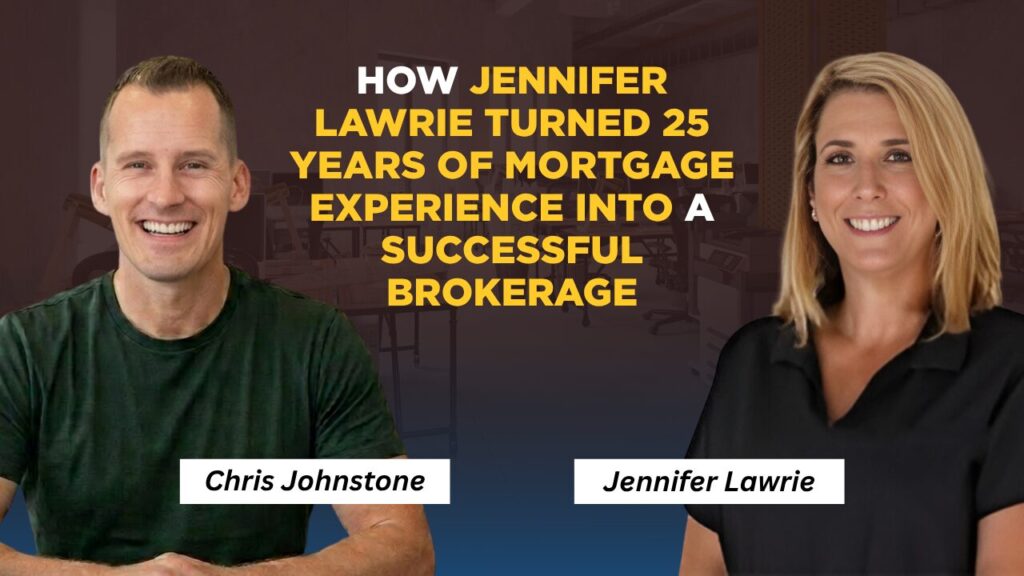
How Jennifer Lawrie Turned 25 Years of Mortgage Experience Into a Successful Brokerage
How Do You Grow a Mortgage Business in a Changing Market?
Building a successful mortgage business does not always require a completely new marketing strategy.
Sometimes, the biggest opportunity is already sitting inside your database.
That was one of the biggest lessons from Jennifer Lawrie, a mortgage professional with 25 years of industry experience. After spending most of her career in retail mortgage lending and the last 16 years in management, Jennifer made a major career change: she became her own broker.
The move forced her to approach her mortgage business differently.
Instead of primarily supporting and managing other people, she was now responsible for generating her own business, maintaining client relationships, building referral partnerships, and creating her own opportunities.
Her response was surprisingly simple.
She went back to the basics.
She contacted her existing database, asked for referrals, cleaned up her CRM, expanded the types of borrowers she served, and began rebuilding professional relationships.
At the same time, she recognized that artificial intelligence is becoming increasingly important in the mortgage industry.
Her experience provides a practical roadmap for loan officers and mortgage brokers who want to generate more referrals, reactivate past clients, strengthen Realtor relationships, and adapt to AI-driven lead generation.
Who Is Jennifer Lawrie?
Jennifer Lawrie has been in the mortgage business for 25 years.
She originally entered the industry after a friend who worked for a builder suggested that she would be good at mortgage lending. At the time, Jennifer had recently had her daughter and was looking for a career that would provide flexibility around childcare.
She decided to give mortgage lending a try.
Twenty-five years later, she remains in the industry.
Throughout her career, Jennifer worked in retail mortgage lending, with the last 16 years focused on management.
But eventually, she decided to make another major change.
She became her own mortgage broker.
According to Jennifer, the move has been more rewarding, more profitable, and less stressful for her.
More importantly, it changed the way she viewed herself professionally.
For years, she described herself as the person supporting the “rainmakers” in the business.
After years of experience, she realized she was capable of being the rainmaker herself.
1. Your Existing Database May Be Your Biggest Mortgage Lead Source
One of the most important lessons from Jennifer Lawrie’s experience is the value of an existing database.
When she became her own broker, she did not immediately start building an elaborate advertising campaign.
She started with people she already knew.
Jennifer had spent years originating loans and had built what she described as a very strong book of business.
Her first strategy was straightforward:
- Text previous contacts
- Email her database
- Call people personally
- Explain what she was doing
- Ask for their business
- Ask for referrals
The important part was that she actually asked.
For years, Jennifer had not needed to directly ask many of these people for business.
When she became independent, that changed.
She realized that having a large database is only valuable when you actively communicate with it.
Why Mortgage Database Reactivation Matters
Many loan officers have hundreds or thousands of contacts sitting inside a CRM.
Those contacts may include:
- Past borrowers
- Previous leads
- Realtors
- Friends
- Family
- Referral partners
- Former clients
- Professional contacts
- People who previously requested mortgage information
But simply having their information inside a mortgage CRM does not generate business.
The database needs to be activated.
Jennifer’s experience demonstrates a simple mortgage marketing principle:
People cannot refer business to you if they do not know you are looking for it.
2. Ask for Mortgage Referrals Directly
Jennifer’s referral strategy was not complicated.
She did not describe a complicated script or sophisticated sales funnel.
Instead, she allowed the conversation to happen naturally.
She would catch up with someone, ask about their family and life, explain what she was doing, and then tell them she was starting over and would appreciate referrals.
This approach works because it provides context.
Rather than randomly calling someone and immediately asking for business, she explained why she was reaching out.
For loan officers, this is an important distinction.
A referral request does not always have to feel like a sales pitch.
It can simply be a conversation.
A Simple Referral Conversation for Loan Officers
A loan officer could structure the conversation around four basic steps:
Step 1: Reconnect
Ask about the person’s life, family, business, or current situation.
Step 2: Explain What Has Changed
Tell them what you are currently doing in your mortgage business.
Step 3: Clearly Ask
Let them know you are looking for new clients or referrals.
Step 4: Make the Request Specific
Ask them to keep you in mind if they hear from someone who needs mortgage financing.
The important lesson is not the exact wording.
It is the willingness to ask.
3. Go Back to “Loan Officer 101”
After becoming independent, Jennifer also revisited coaching notes from approximately two years of coaching she had received during the pandemic.
Her conclusion was that she needed to return to the fundamentals.
She described this as going back to Loan Officer 101.
That included:
- Following a Monday-through-Friday system
- Cleaning up her CRM
- Reconnecting with people
- Making calls
- Asking for referrals
- Creating accountability
- Staying consistent
Jennifer believes many loan officers can become distracted by social media and newer marketing strategies.
She likes social media, but her experience showed her that modern marketing does not eliminate the importance of basic mortgage sales activities.
The Mortgage Marketing Fundamentals
Before investing heavily in complicated marketing campaigns, loan officers should make sure the fundamentals are working.
That means:
Database + Communication + Follow-Up + Referrals + Relationships + Consistency
These activities may not be as exciting as the latest AI tool or social media trend, but they remain foundational to a referral-based mortgage business.
4. Your Mortgage Niche Should Be Broad Enough to Create Opportunity
Jennifer historically built her business around first-time homebuyers and down payment assistance.
That positioning worked well for her.
However, she operates in Northern California, where affordability has made first-time homebuyers more difficult to reach.
Instead of abandoning her expertise, she expanded the market where she could apply it.
She began working with borrowers outside her immediate geographic market through her brokerage.
That allowed her to continue serving borrowers who fit her expertise while reaching markets where that niche could be more practical.
She also mentioned closing three mobile home transactions during the year, something she had not expected to do previously.
The Lesson for Mortgage Brokers
Having a niche can be powerful.
But a niche should not become a limitation.
Loan officers can maintain their expertise while considering:
- Different geographic markets
- Different borrower profiles
- Different property types
- First-time buyers
- Down payment assistance
- Mobile homes
- Self-employed borrowers
- Investment properties
- Other specialized mortgage programs
The specific opportunities available will depend on licensing, product availability, lender guidelines, and market conditions.
The broader lesson is to identify where your expertise solves a real problem.
5. Realtor Referrals Remain a Major Opportunity
One of the biggest themes of Jennifer’s conversation was Realtor relationships.
Jennifer openly admitted that Realtor prospecting is not her strongest skill.
She does not enjoy cold outreach.
For many years, she had approximately five Realtor relationships that consistently produced business.
But after becoming independent, she realized that those relationships were no longer enough.
That forced her to step outside her comfort zone.
She recently called a Realtor she did not previously have a close relationship with and invited them to coffee.
The meeting went well.
She then scheduled additional Realtor meetings.
For Jennifer, this represented a return to fundamentals.
Why Realtor Relationships Matter for Loan Officers
A strong real estate agent relationship can create recurring referral opportunities.
Jennifer explained that while other professional referral sources such as CPAs and divorce attorneys can be valuable, a strong Realtor relationship can potentially produce business much more frequently.
Her point was not that other referral partners are unimportant.
It was that the right Realtor relationship can become a consistent source of mortgage opportunities.
6. Turn Every Mortgage Transaction Into a Referral Opportunity
Chris Johnstone suggested another strategy during the conversation:
Go back through previous transactions and identify the Realtors involved in each transaction.
That includes listing agents and other professionals connected to the transaction.
The objective is not simply to look at the transaction as a closed loan.
Instead, look at every transaction as the beginning of a potential professional relationship.
For loan officers, this creates a valuable exercise:
Review Your Closed Loans
For each transaction, identify:
- Borrower
- Buyer’s agent
- Listing agent
- Referral source
- Other professionals involved
- Geographic market
- Property type
Then ask:
Who should I reconnect with?
This can turn an old transaction database into a new Realtor prospecting list.
7. Train Your Realtor Partners to Become Your “Cheerleaders”
Jennifer made another important observation:
A good Realtor can become one of your best marketing assets.
She shared an example of a Realtor who referred another agent to her after a conversation in an office meeting.
That referral created a new deal opportunity.
This demonstrates the potential of relationship-based referral marketing.
Instead of relying entirely on a loan officer to find every client, satisfied Realtor partners can introduce the loan officer to other professionals.
Jennifer described the goal as training your agents to become your biggest cheerleaders.
How Loan Officers Can Encourage Realtor Referrals
Start by becoming extremely useful to your Realtor partners.
That can include:
- Fast communication
- Strong pre-approval processes
- Clear updates
- Helping solve difficult loan problems
- Educating buyers
- Providing useful mortgage content
- Helping Realtors communicate financing options
- Following through consistently
- Making the Realtor look good to their client
When a Realtor trusts a loan officer, recommending that loan officer becomes easier.
8. Accountability Is Especially Important for Remote Loan Officers
Another interesting part of Jennifer’s story is the changing work environment.
Earlier in her career, she worked in an office surrounded by other mortgage professionals.
There were coworkers, teams, activity, appointments, and accountability.
Today, she works from home.
Her office is essentially herself and her dog.
That creates a different challenge.
It can be easy to tell yourself that you will make three prospecting appointments and then spend the afternoon doing something else.
This is why Jennifer emphasized communities, office hours, Zoom sessions, and accountability groups.
Why Mortgage Sales Accountability Matters
A mortgage business can become isolated.
Loan officers working remotely may benefit from:
- Peer accountability groups
- Weekly goal-setting
- CRM check-ins
- Prospecting sessions
- Virtual office hours
- Coaching
- Team meetings
- Daily activity tracking
The technology is different, but the underlying principle is the same:
Consistent activity becomes easier when someone or something keeps you accountable.
9. AI Is Becoming Part of Mortgage Lead Generation
Artificial intelligence was another major topic in Jennifer Lawrie’s conversation.
At the time of the interview, Jennifer had not yet received a mortgage lead directly from ChatGPT or another AI platform.
However, she was actively learning about AI.
She mentioned using:
- ChatGPT
- Claude
- Addy AI
She described using Claude for business-related work and ChatGPT for personal conversations.
She had also signed up for an AI-related service and planned to attend a class focused on interacting with AI systems to potentially generate referrals.
This distinction is important.
Jennifer was not claiming that AI had already become a major source of her mortgage production.
Instead, she recognized that AI was becoming increasingly relevant to the mortgage industry.
10. Mortgage Professionals Need to Think About AI Search Visibility
Traditional search behavior is changing.
People increasingly use conversational AI tools to research products, services, businesses, and professionals.
For mortgage brokers and loan officers, that raises a new marketing question:
Can potential borrowers discover you through AI-powered search?
Jennifer had not yet received a ChatGPT referral herself at the time of recording, but she recognized the direction of the industry.
Chris explained that building authority and creating useful content are important components of becoming visible in AI-driven discovery.
That means loan officers should think beyond traditional SEO.
Mortgage SEO and AI Search Optimization
A strong online presence can include:
- A professional website
- Educational mortgage articles
- Local SEO
- Google Business Profile
- Social media
- YouTube
- Helpful FAQs
- Mortgage guides
- Client education
- Consistent professional information
The objective should not be to produce content simply because an algorithm exists.
The objective is to build a useful digital footprint that clearly communicates:
Who you help + What you specialize in + Where you work + Why people can trust you
11. AI Is Also Entering the Mortgage Workflow
Jennifer gave an example showing that AI is already appearing inside everyday mortgage operations.
She was working on a difficult conventional loan that required an exception.
She requested a letter of explanation and recognized that the response appeared to have been generated by AI.
Her reaction was essentially that AI is already everywhere and will continue moving deeper into the mortgage business.
This points to a larger trend.
AI is not limited to marketing.
Mortgage professionals may encounter AI across areas such as:
- Content creation
- Client communication
- CRM management
- Lead follow-up
- Administrative work
- Document drafting
- Research
- Customer service
- Marketing
- Lead qualification
The important question for loan officers is not simply whether AI exists.
It is where AI can remove repetitive work while allowing the loan officer to spend more time on relationships and complex decisions.
12. Don’t Let AI Replace the Human Relationship
Jennifer’s story also highlights an important balance.
Technology can help loan officers generate leads, organize information, create content, and automate repetitive processes.
But mortgage lending remains highly relationship-driven.
Borrowers often have questions involving:
- Financing
- Credit
- Income
- Down payments
- Closing costs
- Property types
- Loan programs
- Documentation
- Complicated financial circumstances
Technology can assist with information and processes.
But trust remains important.
That is why Jennifer’s strategy combines traditional relationship marketing with modern technology.
Her approach is not:
AI instead of relationships.
It is closer to:
Relationships + fundamentals + technology.
13. Build a Mortgage Business Around Your Strengths
Jennifer’s career also demonstrates that loan officers do not all have the same strengths.
She has spent years in management and supporting teams.
She described herself as someone who was excellent at propping up and supporting her team.
When she became an independent broker, she had to learn how to sell herself rather than primarily supporting other people.
That required a mindset change.
For experienced mortgage professionals, this raises an important question:
Are you spending most of your time supporting someone else’s production when you could also be building your own?
There is no universal answer.
Jennifer specifically cautioned that her experience should not be treated as a blanket recommendation for everyone to become a broker.
She acknowledged that her 24 years of industry support and experience gave her a foundation that helped her transition.
The broader lesson is to evaluate your own experience, infrastructure, relationships, compliance requirements, operational support, and business goals before making a similar decision.
14. A Practical Mortgage Business Growth Framework
Jennifer Lawrie’s interview can be turned into a simple framework for loan officers and mortgage brokers.
Step 1: Clean Your CRM
Make sure your database is organized.
Identify:
- Past clients
- Referral partners
- Realtors
- Prospects
- Old leads
- Professional contacts
Step 2: Reactivate Your Database
Start communicating with people again.
Do not immediately turn every interaction into a sales pitch.
Reconnect first.
Step 3: Tell People What You Do
Make sure your database knows what you currently offer and who you help.
Step 4: Ask for Referrals
Do not assume people know you are looking for business.
Ask.
Step 5: Review Past Transactions
Look at your closed loans and identify Realtors and other professionals you should reconnect with.
Step 6: Expand Realtor Relationships
If you have relied on the same small group of Realtors for years, start building additional relationships.
Step 7: Create Accountability
Use peer groups, coaching, Zoom sessions, office hours, or scheduled prospecting blocks.
Step 8: Expand Your Market Carefully
Identify borrower niches and geographic areas where your expertise can create value.
Step 9: Build Your Digital Authority
Create useful mortgage content across your website, social media, YouTube, and other relevant channels.
Step 10: Learn AI
Experiment with AI tools that can help with:
- Content
- Research
- CRM workflows
- Communication
- Marketing
- Administrative tasks
15. Mortgage Marketing Strategies Loan Officers Can Use Today
Based on Jennifer Lawrie’s experience, loan officers can focus on several complementary marketing channels.
Database Marketing
Reconnect with past clients and existing contacts.
Referral Marketing
Ask previous borrowers and professional contacts for introductions.
Realtor Marketing
Build long-term relationships with real estate professionals.
Local SEO
Create a strong presence for mortgage-related searches in your service areas.
Social Media Marketing
Use social platforms to demonstrate expertise and personality.
YouTube Marketing
Create educational mortgage videos that answer borrower questions.
Content Marketing
Publish useful mortgage guides, FAQs, and educational articles.
AI Search Optimization
Build authoritative online content that clearly communicates your expertise and services.
CRM Marketing
Use a mortgage CRM to organize contacts, follow-ups, referrals, and opportunities.
The most effective approach does not have to rely on a single channel.
A mortgage business can combine relationship marketing with digital marketing and technology.
16. What Jennifer Lawrie’s Story Teaches Loan Officers
Jennifer’s experience offers several practical lessons.
Lesson 1: Your database already contains opportunities
Before spending heavily on new lead sources, revisit the people who already know you.
Lesson 2: Ask for referrals
People may not realize you are looking for business unless you tell them.
Lesson 3: Go back to fundamentals
CRM organization, follow-up, phone calls, referrals, and consistency still matter.
Lesson 4: Don’t become trapped by one niche
Your expertise can potentially be applied to different markets and borrower groups.
Lesson 5: Realtor relationships remain important
The right Realtor relationship can generate recurring referral opportunities.
Lesson 6: Build accountability into your routine
Working remotely makes discipline and structure even more important.
Lesson 7: Start learning AI before you need it
AI is already entering mortgage marketing and mortgage operations.
Lesson 8: Build your digital authority
Your website, social media, videos, reviews, and educational content contribute to how people discover and evaluate you.
17. The Future of Mortgage Marketing: Relationships and AI
Jennifer Lawrie’s story represents a transition happening throughout the mortgage industry.
Traditional relationship marketing is still important.
At the same time, technology is changing how borrowers discover information and how mortgage professionals perform daily tasks.
Loan officers therefore have two opportunities.
The first is to strengthen the relationships they already have.
The second is to build a digital presence that makes them discoverable through modern search and AI platforms.
Neither requires abandoning the fundamentals.
In fact, Jennifer’s experience suggests the opposite.
The fundamentals become the foundation.
A clean CRM.
Consistent communication.
Referral requests.
Realtor relationships.
Accountability.
Follow-up.
Then technology can be layered on top.
Conclusion: Go Back to the Basics Before Chasing the Next Big Thing
Jennifer Lawrie’s 25-year mortgage career provides an important lesson for loan officers and mortgage brokers.
When she became her own broker, she did not begin by creating an incredibly complicated marketing machine.
She started with the people she already knew.
She contacted her database.
She asked for referrals.
She cleaned up her CRM.
She returned to the fundamentals she had learned through coaching.
She expanded her borrower niche.
She began rebuilding Realtor relationships.
And she started exploring AI as the mortgage industry continued to change.
The result was a new chapter in her career that she described as more rewarding, more profitable, and less stressful.
For mortgage professionals looking for their next source of growth, the lesson is straightforward:
Before searching for the next complicated strategy, look at the relationships, database, systems, and fundamentals you already have.
Then use modern tools—including AI—to make those fundamentals more scalable.
Frequently Asked Questions About Mortgage Business Growth
How can loan officers generate more mortgage referrals?
Loan officers can generate referrals by consistently communicating with past clients, asking directly for introductions, strengthening Realtor relationships, and staying top-of-mind through useful content and follow-up.
How can mortgage brokers reactivate an old database?
Start by cleaning and organizing the CRM, segmenting contacts, reconnecting personally, updating people about your current business, and asking whether they know anyone who needs mortgage financing.
Why are Realtor relationships important for loan officers?
Realtors can become recurring referral partners because they work directly with homebuyers and sellers. A strong professional relationship can create ongoing opportunities for mortgage referrals.
How can loan officers get more Realtor referrals?
Loan officers can focus on providing value, communicating consistently, helping Realtors serve their clients, reconnecting with agents from previous transactions, and asking existing Realtor partners for introductions to other agents.
Should mortgage brokers use AI?
AI can assist with areas such as content creation, research, communication, administrative work, CRM processes, and marketing. Mortgage professionals should evaluate each tool for privacy, security, compliance, and suitability before using it with client information.
Can ChatGPT generate mortgage leads?
AI-powered search is becoming relevant to how consumers discover businesses and professionals. However, Jennifer Lawrie specifically said that she had not yet received a lead or deal from ChatGPT at the time of the interview.
What should loan officers focus on before investing in new lead sources?
Loan officers can first evaluate their existing database, CRM, past-client relationships, referral partners, Realtor relationships, follow-up systems, and daily prospecting activity.
How can loan officers improve mortgage marketing?
A comprehensive mortgage marketing strategy can combine database marketing, referral marketing, Realtor relationship building, local SEO, social media, YouTube, educational content, CRM follow-up, and emerging AI-search strategies.
📣 Share This With Another Loan Officer!
