How Top Producer Mallory Strotheide Networks With 900 Realtors a Month!
Introduction: Why Referral-Based Mortgage Businesses Still Work
How do you build a successful mortgage business without depending on purchased leads?
For Mallory Strotheide, the answer is relationships.
After entering the mortgage industry in 2009, Mallory initially built her business through cold calling, purchased lists, and internet-driven opportunities. But as her career developed, she made a major shift: she moved toward a 100% referral-based mortgage business.
Today, Mallory says approximately 50–60% of her business comes from Realtors, while another 25–30% comes from past clients and their referrals. She also generates business through social media and other internet opportunities.
Her approach provides an important lesson for loan officers:
You don’t necessarily need to buy more leads. You may need to build a better system for developing relationships, staying in touch with your database, and asking for referrals.
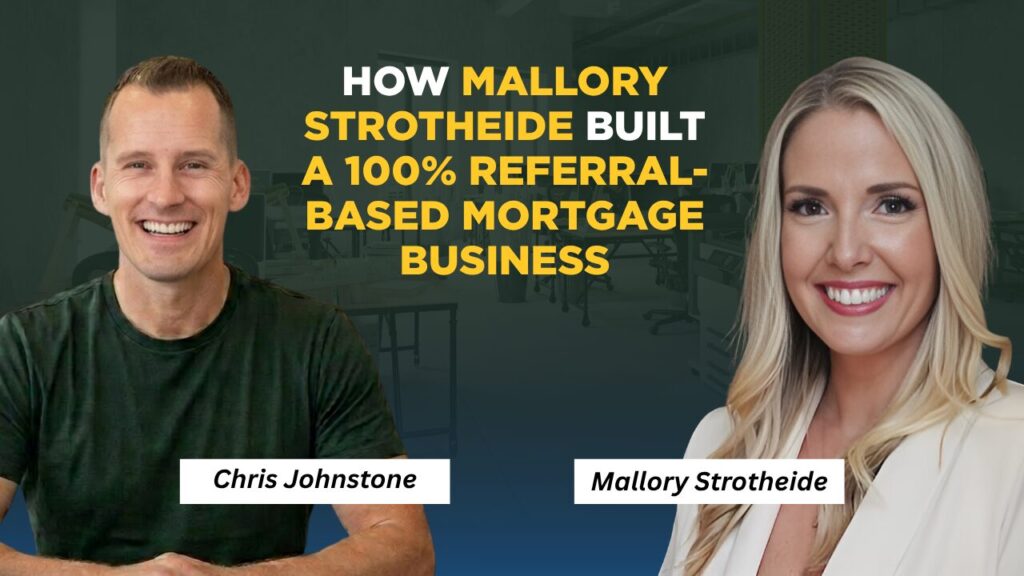
In her conversation with Chris Johnstone on LoanOfficerPodcast.com, Mallory explains how she built a referral-driven mortgage business through Realtor relationships, database marketing, client events, social media, consistent communication, and education.
This guide breaks down the strategies loan officers can learn from Mallory Strotheide and apply to their own mortgage marketing strategy.
Who Is Mallory Strotheide?
Mallory Strotheide entered the mortgage industry in May 2009, shortly after graduating from college with a business communications degree.
The timing was difficult. The economy was struggling, and finding a job was challenging. Mallory was hired by a mortgage company at just 21 years old despite having no background in finance or mortgages.
Her initial role was completely different from the referral-based business she operates today.
She was given lists of potential contacts and spent long days cold calling.
Mallory recalls sitting on the phone from approximately 8 a.m. to 8 p.m., manually dialing prospects and trying to generate mortgage business.
Despite being brand new, she closed four deals during her first month on the floor.
That experience gave her something that would remain valuable throughout her career: the ability to make phone calls, communicate with prospects, and build relationships.
Over time, however, Mallory transitioned away from cold and internet leads.
Around 2015, she made the decision to become referral only.
That became the foundation of the mortgage business she has built since.
How Mallory Strotheide Built a 100% Referral-Based Mortgage Business
The biggest transformation in Mallory’s career was moving from receiving leads to actively creating relationships.
Today, she describes her business as 100% referral-based.
Her approximate business mix is:
- 50–60% Realtor referrals
- 25–30% past clients and their referrals
- Additional business from social media and internet opportunities
This model is fundamentally different from a mortgage business that depends primarily on purchased leads.
Instead of constantly paying for new prospects, Mallory focuses on building an ecosystem of people who already know, trust, and can recommend her.
That includes:
- Realtors
- Past mortgage clients
- Friends and family
- Social media connections
- Community relationships
- New Realtors
- Professional referral partners
The result is a business built around relationships rather than simply lead volume.
Lesson 1: Build Your Mortgage Business Around Relationships
Mallory describes herself as a relationship person.
That personality fits naturally with a referral-based mortgage strategy.
But being relationship-driven doesn’t mean simply collecting business cards or adding people to a CRM.
It means consistently staying connected.
Mallory has developed long-term Realtor relationships while continuing to add new relationships to her network.
This creates two important advantages.
Existing Relationships Create Stability
Long-term Realtor partners can generate repeat opportunities.
When an agent trusts a loan officer, they don’t have to start the lender search from scratch for every buyer.
The relationship becomes an ongoing source of referrals.
New Relationships Create Future Opportunities
Mallory doesn’t ignore new Realtors.
In fact, she actively reaches out to new agents because she believes that some of them will eventually become high-producing Realtors.
Her philosophy is simple:
You don’t always know who the next top producer will be.
For loan officers, this is an important mortgage referral strategy.
Instead of focusing exclusively on today’s biggest Realtor producers, build relationships with ambitious professionals who are actively trying to grow their businesses.
How to Find New Realtor Referral Partners
Mallory has a specific process for identifying new Realtor relationships.
Her local Realtor association provides a list of newly joined agents.
She uses that information to reach out to them.
The first step is usually an email.
If a new Realtor responds and agrees to meet, Mallory views that as a positive signal.
Why?
Because the Realtor has already demonstrated initiative.
From there, she can begin developing the relationship.
This is a scalable approach to Realtor lead generation for loan officers.
Rather than randomly contacting hundreds of agents, loan officers can create a process:
- Identify new Realtors.
- Reach out with something useful.
- Invite them to a conversation.
- Learn about their business.
- Provide education or resources.
- Add them to an appropriate database.
- Continue nurturing the relationship.
- Look for opportunities to collaborate.
The objective isn’t to immediately ask every Realtor for business.
The objective is to build relationships with people who could become valuable long-term partners.
Lesson 2: Focus on Realtors Who Value Relationships
One of Mallory’s most interesting observations is that she doesn’t spend most of her time chasing the biggest Realtor “whales.”
Instead, she says she does particularly well with Realtors producing approximately $3 million to $10 million in business.
For her Michigan market, that’s meaningful production.
She also has relationships with Realtors producing significantly more, including some in the $20 million to $30 million range.
But her preferred Realtor partners tend to be agents who:
- Generate referral business
- Value relationships
- Want to grow
- Are willing to collaborate
- Appreciate education
- Aren’t primarily looking for a lender to fund lead purchases
- Are interested in building a long-term partnership
This provides a useful lesson for loan officer marketing.
The best Realtor partner isn’t necessarily the Realtor with the largest production number.
The best partner may be the one whose business model, values, communication style, and growth goals align with yours.
Lesson 3: Turn Every Transaction Into a Relationship Opportunity
One of the most powerful mortgage referral strategies is to stop thinking about a transaction as a single closed loan.
Every transaction can create multiple future relationships.
For example, a mortgage transaction may involve:
- The buyer
- The buyer’s Realtor
- The listing agent
- Other agents in the office
- Friends and family of the buyer
- Future referral sources
Mallory uses transactions as opportunities to discover and develop new Realtor relationships.
She may encounter a listing agent on the other side of a transaction, research their business, and reach out to establish a relationship.
This creates a simple but powerful strategy:
Look for your next referral partner inside the business you are already doing.
Instead of constantly searching for strangers, examine the people already appearing in your transactions.
Lesson 4: Your Mortgage Database Is One of Your Most Valuable Assets
Mallory places significant emphasis on her database.
Her philosophy is that loan officers should continue communicating with clients long after the mortgage closes.
That matters because a past client can potentially become:
- A repeat borrower
- A refinance client
- A second-home buyer
- A home-equity client
- A referral source
- A source of Realtor introductions
- An advocate for your business
Mallory doesn’t simply put clients into a database and forget about them.
She actively communicates with them.
Her database marketing includes both digital and physical communication.
Mallory Strotheide’s Mortgage Database Marketing Strategy
Mallory uses several different forms of client communication.
Quarterly Direct Mail
Her clients receive a physical mailer approximately every quarter.
In a world dominated by email and social media, she still believes physical mail can stand out because it demonstrates effort.
The key principle isn’t necessarily the mailer itself.
It’s the consistent touchpoint.
Client Events
Mallory organizes approximately one or two larger client events each year.
Examples she discussed include:
- Park parties
- A night at the zoo
- Events involving Realtors and closed clients
These events give her clients and referral partners an opportunity to interact with her outside the mortgage transaction.
Family Photo Sessions
Mallory also organizes quarterly mini family-photo sessions.
Clients can sign up for a complimentary family photo session, generally limited to one per year.
This is a creative example of client retention marketing.
Instead of simply sending promotional material, she creates something her clients can actually enjoy.
Birthday and Home Anniversary Outreach
Mallory also communicates around:
- Birthdays
- Home anniversaries
- Market updates
- Other personal milestones
She aims to have some form of communication—call, text, or email—happen approximately once per month.
The strategy is straightforward:
Stay relevant before the client needs you again.
Why Past Client Marketing Is So Important for Loan Officers
A mortgage transaction may last several weeks or months.
The relationship can last decades.
That creates an enormous opportunity for mortgage professionals.
Consider a borrower who closes a home purchase today.
Over the next several years, that borrower could:
- Refer a family member
- Refer a coworker
- Refer a friend
- Purchase another home
- Buy a second home
- Refinance
- Use home equity
- Introduce a Realtor
- Become a repeat client
But none of that is guaranteed.
The loan officer needs to stay connected.
That’s why a mortgage database marketing strategy should extend far beyond the original transaction.
Lesson 5: Ask for Referrals When Clients Are Happiest
One of Mallory’s most actionable strategies is how she asks current clients for referrals.
She says she has become more intentional about directly asking for the business.
But timing matters.
She likes to ask when the client is happy and engaged.
One example is immediately after the client receives their pre-approval.
Instead of using a complicated script, the conversation can be straightforward:
“Do you know anybody else who’s looking to buy a house in the next six months?”
The important part is the context.
The client has just experienced a positive milestone.
They’re excited.
They’re thinking about buying a home.
And the loan officer has an opportunity to remind them that referrals are an important part of the business.
Why Loan Officers Should Be Specific When Asking for Referrals
Another important lesson from Mallory is that clients don’t always understand everything a loan officer can do.
A borrower might associate you only with the mortgage they recently received.
They may not know that you also help with:
- Refinancing
- Second homes
- Home equity
- Other mortgage products
- Different types of purchase transactions
Mallory learned that being more specific can create additional opportunities.
Instead of saying:
“Send me anyone who needs a mortgage.”
You might educate your database about the specific situations you can help with.
For example:
- “I can help if someone is buying a second home.”
- “I can help homeowners explore refinancing.”
- “I can help buyers understand home financing options.”
- “I can help homeowners evaluate home-equity options.”
The goal is to make it easier for clients to recognize when someone they know needs your expertise.
Lesson 6: Don’t Be Afraid to Tell People You Need Referrals
A common mistake in referral marketing is assuming people automatically know you want referrals.
They don’t.
Even if clients know you’re a loan officer, they may not know:
- That your business is referral-based
- That you’re accepting new clients
- That you have capacity
- That you want introductions
- That you offer multiple mortgage products
Mallory has experienced this firsthand.
She says clients have sometimes worried that she’s too busy to take a referral.
That means the loan officer needs to communicate clearly.
If you have capacity, tell people.
If you’re looking for referrals, tell people.
If you specialize in a particular type of borrower, tell people.
People can’t refer you for something they don’t know you do.
Lesson 7: Create Value for Realtors Through Education
Mallory has developed an especially interesting strategy for Realtor relationships: a monthly Realtor Bootcamp.
The event is designed around education.
She invites Realtors in her network and provides useful information through presentations and guest speakers.
The topics can involve professionals and organizations relevant to the real estate industry.
For example, Mallory discussed bringing in:
- Appraisers
- Housing organizations
- Other industry professionals
- Down payment assistance experts
Her goal isn’t simply to create another sales event.
The goal is to create a place where Realtors can learn.
This is an excellent example of value-based Realtor marketing.
How to Build a Realtor Education Event
Loan officers can adapt Mallory’s Realtor Bootcamp concept.
A simple monthly Realtor education program could cover topics such as:
Mortgage Education
- Pre-approval strategies
- Common underwriting issues
- Financing options
- First-time buyer financing
- Self-employed borrowers
Market Education
- Local housing trends
- Inventory
- Interest-rate discussions
- Buyer behavior
Transaction Education
- Appraisals
- Inspections
- Closing processes
- Common financing delays
Marketing Education
- Social media
- Personal branding
- Database marketing
- AI tools
Local Resources
Invite specialists to educate Realtors about programs and resources available in the market.
The key is consistency.
One event isn’t a strategy.
A recurring event can become an asset.
Lesson 8: Use Events to Become Known in Your Community
Events can accomplish something that digital advertising cannot fully replicate: personal familiarity.
When Realtors repeatedly see a loan officer:
- Hosting educational events
- Bringing useful speakers
- Supporting clients
- Participating in the community
- Sharing helpful information
the loan officer begins to become associated with expertise and value.
This contributes to reputation.
And reputation matters enormously in a referral-based mortgage business.
Mallory’s strategy demonstrates that mortgage marketing doesn’t always have to be about asking for business.
Sometimes the best marketing is simply becoming the person people associate with useful information and reliable relationships.
Lesson 9: Social Media Can Become a Referral Channel
Mallory also generates business through social media.
Her primary platforms are Facebook and Instagram.
Interestingly, she says Facebook has been particularly valuable because it allows her to connect with clients and maintain relationships.
Her approach is different from treating social media as a digital billboard.
She uses social media to stay connected with people.
She shares personal content and mixes in business content.
That distinction is important.
Personal Relationships Create Business Opportunities
Mallory doesn’t believe every post needs to be a mortgage advertisement.
Instead, her social media presence allows people to see:
- Her personality
- Her life
- Her interests
- Her family
- Her mortgage expertise
- Her business activities
This creates familiarity.
And familiarity can lead to conversations.
How Often Should Loan Officers Post on Social Media?
Mallory says she posts approximately five days a week.
Her content includes a combination of personal and business material.
Her mortgage content focuses heavily on consumers.
Topics can include:
- Home buying
- Getting pre-approved
- Mortgage education
- Trends
- Helpful information
- Entertaining content
- Fun social media trends
She deliberately tries to avoid making every post feel like a mortgage lecture.
That is a valuable lesson for mortgage social media marketing.
People don’t necessarily follow loan officers because they want to read mortgage guidelines every day.
They follow people they find interesting, helpful, authentic, and trustworthy.
Lesson 10: Make Mortgage Content Educational and Human
Mallory’s philosophy is to educate consumers while allowing her personality to show.
This creates a useful formula for loan officer content:
Education + Personality + Consistency + Authenticity
For example, instead of creating only:
“Today’s mortgage guideline update…”
A loan officer could create:
- “Three things first-time buyers should know before getting pre-approved”
- “What actually happens after you submit a mortgage application?”
- “Why your monthly payment can be higher than you expect”
- “Three questions to ask before buying a second home”
- “What Realtors wish buyers knew about pre-approval”
The objective is to answer questions people actually have.
Lesson 11: Use Personal Social Media to Strengthen Relationships
One of Mallory’s strongest observations is that her personal social media accounts can generate referrals.
That’s because her personal network includes:
- Family
- Friends
- Past clients
- Referral partners
- Local contacts
- Professional connections
This creates a larger relationship ecosystem.
Her business page can demonstrate mortgage expertise.
Her personal profile can reinforce the person behind the business.
For a relationship-driven loan officer, both can be valuable.
Lesson 12: AI Will Change Mortgage Marketing, But It Won’t Replace Relationships
AI was an important part of Mallory’s discussion with Chris Johnstone.
She already uses ChatGPT every day and is beginning to explore Claude.
However, her view of AI is not that it will replace the loan officer.
Instead, she sees AI as a way to free up time.
Her philosophy can be summarized as:
Use technology to work smarter, not harder.
AI and automation can potentially help mortgage professionals spend less time on repetitive work and more time on:
- Clients
- Realtors
- Referral partners
- Consultations
- Relationships
- Business development
That distinction is important.
The future of mortgage marketing may not be humans versus AI.
It may be humans using AI to become more effective.
Lesson 13: Loan Officers Need to Start Thinking About AI Search
Mallory also revealed an important gap in her current marketing strategy.
When she searched Google for top loan officers in West Michigan, she didn’t find herself.
She also had not yet received a referral from ChatGPT.
That led to an important realization:
Having a strong reputation isn’t enough if your online presence doesn’t clearly communicate your expertise to search engines and AI systems.
This is becoming increasingly relevant to loan officers.
Consumers can search for mortgage information using traditional search engines and AI tools.
They may ask questions such as:
- Who is a good loan officer in my area?
- Who specializes in first-time homebuyers?
- Who can help with down payment assistance?
- Who offers second-home financing?
- Who is a trusted mortgage lender near me?
Loan officers need to think about how their online presence answers those questions.
How Loan Officers Can Improve AI Search Visibility
A strong AI search strategy starts with a strong digital presence.
Loan officers should clearly communicate:
Who You Are
Make sure your name and professional identity are consistent online.
Where You Work
Clearly communicate the cities, counties, states, and markets you serve.
Who You Help
Explain the borrowers and situations you specialize in.
What You Offer
Clearly describe your mortgage products and areas of expertise.
What Questions You Answer
Create educational content around real borrower questions.
Why People Trust You
Reviews, testimonials, media appearances, educational content, and community involvement can all contribute to your online authority.
Lesson 14: Your Google Reviews and Online Reputation Matter
Chris pointed out that Mallory had 47 five-star Google reviews during the conversation.
That provides an important lesson.
A referral-based business is built on trust.
Today, consumers don’t only ask friends and Realtors for recommendations.
They can also research a loan officer online.
Reviews provide social proof.
A strong online reputation can support:
- Google search visibility
- Local discovery
- Consumer confidence
- Referral decisions
- AI discovery
- Brand credibility
For loan officers, building a review-generation process should be part of the overall marketing strategy.
The goal isn’t simply to collect reviews.
It’s to consistently deliver an experience worth reviewing.
Lesson 15: Combine Traditional Marketing With Modern Technology
One of the most interesting aspects of Mallory’s strategy is that she doesn’t abandon traditional marketing just because new technology exists.
She uses:
- Phone calls
- Direct mail
- Client events
- Realtor events
- Database marketing
- ChatGPT
- Emerging AI tools
This creates a hybrid marketing strategy.
The lesson is important:
The newest marketing channel doesn’t automatically replace the old ones.
A handwritten or physical piece of mail can still stand out.
A phone call can still create a relationship.
A client event can still create loyalty.
Social media can maintain visibility.
AI can help with productivity and content.
The strongest mortgage marketing strategy may combine all of them.
A Practical Referral Marketing System for Loan Officers
Based on Mallory Strotheide’s approach, a loan officer can build a simple referral marketing system around five core areas.
1. Build a Realtor Network
Identify:
- Existing Realtor partners
- New Realtors
- Listing agents
- Agents in your local market
- Realtors who value referrals
- Realtors who are actively growing
Create a consistent outreach process.
2. Build a Past Client Database
Every closed borrower should enter a long-term relationship system.
Track:
- Name
- Contact information
- Closing date
- Home anniversary
- Birthday
- Realtor
- Loan type
- Potential future needs
3. Communicate Consistently
Use a combination of:
- Calls
- Texts
- Emails
- Direct mail
- Social media
- Events
The objective is consistent visibility.
4. Ask for Specific Referrals
Don’t simply say:
“Let me know if you know anyone who needs a mortgage.”
Be specific.
Ask about:
- Buyers
- Refinances
- Second homes
- Home equity
- First-time buyers
- Specific local programs
Make it easier for people to identify potential referrals.
5. Create Value
Give your network reasons to stay connected.
That could include:
- Educational events
- Market updates
- Homebuyer guides
- Social media education
- Client events
- Family events
- Realtor Bootcamps
- Useful resources
A Weekly Mortgage Referral Marketing Plan
Loan officers looking for a practical routine can adapt Mallory’s relationship-first approach into a weekly system.
Monday: Database Outreach
Contact past clients.
Ask:
- How are they doing?
- How is the home?
- Do they need anything?
- Is anyone they know planning to move?
Tuesday: Realtor Outreach
Contact existing Realtor partners and new agents.
Focus on starting conversations rather than immediately asking for loans.
Wednesday: Educational Content
Publish useful mortgage content.
Focus on questions consumers actually ask.
Thursday: Relationship Building
Schedule:
- Realtor meetings
- Client calls
- Community meetings
- Referral partner conversations
Friday: Social Media and Follow-Up
Review conversations from the week.
Follow up with:
- Prospects
- Realtors
- Past clients
- Event attendees
- Social media conversations
The important thing is consistency.
How to Measure a Referral-Based Mortgage Business
Referral marketing should not mean ignoring numbers.
In fact, Mallory’s approach shows that relationship marketing can still be systematic.
Track:
Realtor Metrics
- Number of active Realtor relationships
- New Realtor conversations
- Realtor meetings
- Referrals received
- Loans closed from Realtor referrals
Database Metrics
- Number of past clients
- Contacts completed
- Referrals requested
- Referrals received
- Repeat transactions
- Past-client revenue
Social Media Metrics
- Followers
- Engagement
- Direct messages
- Conversations
- Referral inquiries
- Closed loans from social media
Event Metrics
- Invitations
- Registrations
- Attendance
- Follow-up conversations
- New relationships
- Referrals generated
The goal is to connect marketing activity to business outcomes.
The Mallory Strotheide Mortgage Business Model
Mallory’s approach can be summarized as:
Relationships → Consistent Communication → Value → Trust → Referrals → Repeat Business
Each part supports the next.
Relationships
Build genuine connections with Realtors, clients, and people in your community.
Consistent Communication
Stay visible through calls, mail, email, social media, and events.
Value
Educate and help people without making every interaction a sales pitch.
Trust
Deliver a strong experience and demonstrate expertise.
Referrals
Ask satisfied clients and partners to introduce you to people they know.
Repeat Business
Stay connected long enough to benefit from future purchases, refinances, and referrals.
This is what makes referral marketing powerful.
What Loan Officers Can Learn From Mallory Strotheide
Mallory’s story demonstrates that a mortgage business doesn’t have to depend entirely on purchased leads.
Her career started with cold calling.
She eventually transitioned into a business built around relationships.
Today, her business is primarily driven by:
- Realtor referrals
- Past clients
- Client referrals
- Social media
- Database marketing
- Community relationships
- Events
Her strategy is not based on one marketing tactic.
It’s based on an ecosystem.
And that’s perhaps the biggest lesson.
A successful referral-based mortgage business is built one relationship at a time—but managed with systems.
Key Takeaways From Mallory Strotheide
1. Build Relationships Before You Need Referrals
Long-term relationships can become a consistent source of mortgage business.
2. Your Database Is an Asset
Past clients can generate repeat business and referrals for years.
3. Communicate More Than Once a Year
Use calls, texts, emails, direct mail, social media, and events to stay relevant.
4. Ask for Referrals
Don’t assume clients know you want introductions.
5. Be Specific
Tell people exactly what types of borrowers and mortgage situations you can help with.
6. Don’t Ignore New Realtors
Today’s new Realtor could become tomorrow’s top producer.
7. Educate Realtors
A recurring Realtor Bootcamp can create value while strengthening relationships.
8. Use Social Media to Build Relationships
Don’t make every post a sales pitch.
9. Combine Personal and Business Content
Let people see the person behind the mortgage professional.
10. Use AI to Create More Time
AI can help with repetitive work, research, content, and productivity.
11. Start Thinking About AI Search
Make your online presence clear enough for both consumers and AI systems to understand.
12. Protect Your Reputation
Reviews, community involvement, content, and consistent service all contribute to your digital reputation.
Frequently Asked Questions About Building a Referral-Based Mortgage Business
How do loan officers get more Realtor referrals?
Loan officers can generate more Realtor referrals by developing genuine relationships, consistently providing value, communicating regularly, educating agents, hosting events, and delivering a reliable client experience. Mallory Strotheide emphasizes building relationships with both established Realtors and new agents who demonstrate ambition.
What percentage of Mallory Strotheide’s mortgage business comes from referrals?
Mallory Strotheide describes her business as 100% referral-based. She estimates that approximately 50–60% comes from Realtors, while approximately 25–30% comes from past clients and their referrals. She also receives some business through social media and other internet opportunities.
How can loan officers generate referrals from past clients?
Loan officers can stay connected through regular calls, texts, emails, direct mail, client events, birthdays, home anniversaries, market updates, and social media. They should also directly ask satisfied clients for referrals at appropriate moments.
How often should loan officers contact their database?
There is no single required frequency, but Mallory describes a system involving regular monthly communication combined with quarterly mailers, annual or recurring events, personal milestone outreach, and social media interaction.
Should loan officers buy mortgage leads?
Mallory’s experience demonstrates that a loan officer can build a business without purchasing leads. After initially working cold and internet leads, she transitioned to a 100% referral-based model. Whether purchased leads make sense depends on an individual loan officer’s business model, conversion rates, budget, and capacity.
How can loan officers build Realtor relationships?
Loan officers can identify Realtors in their market, reach out consistently, offer educational resources, host Realtor events, collaborate on marketing, and focus on creating value rather than immediately asking for business.
What is a Realtor Bootcamp?
A Realtor Bootcamp is an educational event designed to help real estate agents learn about topics that can improve their businesses. Mallory Strotheide hosts a monthly Realtor Bootcamp with presentations and guest speakers.
How can AI help mortgage loan officers?
AI can help loan officers with tasks such as research, content creation, organization, communication, and repetitive work. Mallory uses ChatGPT regularly and is beginning to explore Claude. Her philosophy is that AI should help free up time for human relationship building rather than replace the human element of mortgage lending.
How can loan officers get found in AI search?
Loan officers should build a clear digital presence that explains who they are, where they work, who they help, what mortgage products they offer, and what expertise they have. Educational content, reviews, social media, websites, and other credible online sources can help establish a stronger digital footprint.
Is social media effective for mortgage lead generation?
Mallory Strotheide says she receives business from Facebook and Instagram. Her strategy combines personal relationship-building with consumer-focused mortgage education and consistent posting.
How important are Google reviews for loan officers?
Reviews can provide social proof and help demonstrate credibility when consumers research mortgage professionals online. Mallory had 47 five-star Google reviews at the time of the podcast conversation.
Final Thoughts: Build a Mortgage Business People Want to Refer
Mallory Strotheide’s journey from cold-calling mortgage prospects in 2009 to building a 100% referral-based mortgage business demonstrates the long-term power of relationships.
Her strategy isn’t based on one complicated marketing hack.
It’s built on fundamentals:
Know people.
Stay in touch.
Provide value.
Ask for referrals.
Educate your partners.
Take care of your clients.
Use technology to create more time for relationships.
Her approach also demonstrates that traditional relationship marketing and modern technology don’t have to compete.
A loan officer can send a physical mailer and use ChatGPT.
They can host a Realtor Bootcamp and post on Instagram.
They can make phone calls and use AI.
They can build a database while building a personal brand.
The opportunity is to combine these tools into one consistent system.
For loan officers who want to grow a referral-based mortgage business, the most important question may not be:
“How can I buy more leads?”
Instead, ask:
“How can I become the loan officer that more people naturally want to refer?”
That shift—from chasing leads to building relationships—can fundamentally change the way a mortgage business grows.
About the LoanOfficerPodcast.com Episode
In this LoanOfficerPodcast.com episode, host Chris Johnstone interviews Mallory Strotheide about her journey in the mortgage industry, her transition to a 100% referral-based mortgage business, Realtor relationship strategies, database marketing, client events, social media, AI, and the future of mortgage marketing.
The conversation provides practical lessons for loan officers, mortgage professionals, Realtors, and mortgage business owners looking to improve referral generation, client retention, database marketing, and business growth.
Listen to the full LoanOfficerPodcast.com episode with Mallory Strotheide to hear her strategies and experiences directly.
📣 Share This With Another Loan Officer!
