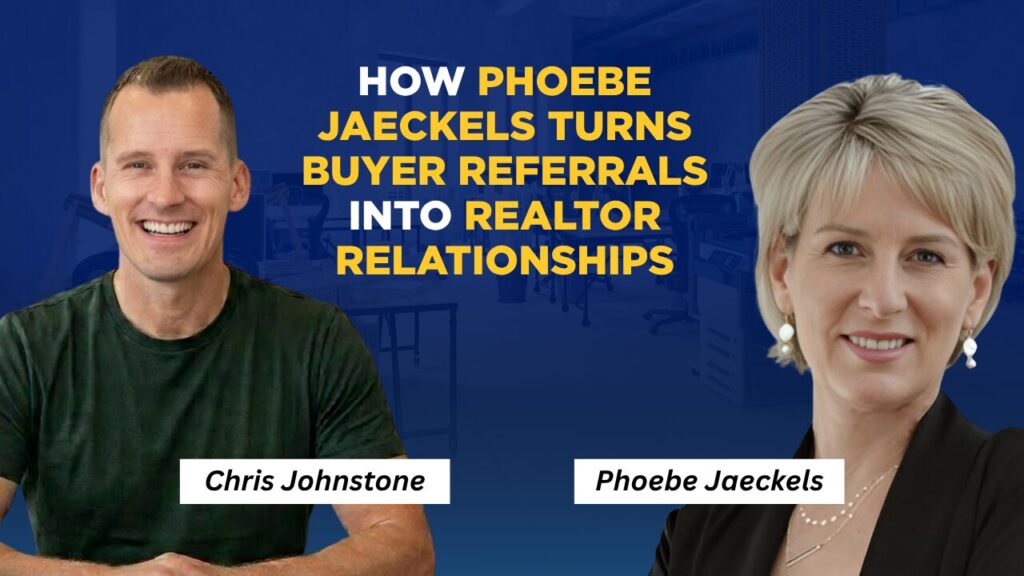
How Phoebe Jaeckels Turns Buyer Referrals Into Realtor Relationships & Closed Loans
Introduction: The Mortgage Business Is Still a Relationship Business
Technology has changed how consumers search for information, how loan officers market themselves, and how mortgage professionals communicate with borrowers.
But one thing hasn’t changed:
People still want someone they can trust when making one of the biggest financial decisions of their lives.
That is one of the central lessons from Phoebe Jaeckels, a mortgage professional who has spent more than three decades working in real estate and mortgage lending.
Phoebe started with a real estate license in 1990 and spent approximately seven years selling real estate before moving into mortgage lending in 2004.
That real estate background became an important advantage.
She understood what buyers needed.
She understood what sellers needed.
And she understood the pressure that Realtors experience during a transaction.
Her mortgage career then gave her another powerful advantage: she learned how to underwrite her own files while working for a large bank.
That combination of real estate experience + mortgage expertise + underwriting knowledge + relationship building became the foundation of her business.
Today, Phoebe describes her business as heavily referral-based.
She works extensively with Realtors, receives referrals from friends and family, uses social media to stay visible, and focuses heavily on taking care of the people she serves.
Her philosophy is straightforward:
Know your job, solve problems, communicate clearly, and make the people around you look good.
This guide breaks down the strategies Phoebe Jaecles discussed with Chris Johnstone on LoanOfficerPodcast.com and explains how loan officers can apply those lessons to build a stronger referral-based mortgage business.
Who Is Phoebe Jaeckels?
Phoebe Jaeckels began her real estate career in 1990, shortly after graduating from high school.
She obtained her real estate license and moved to a different area, where she spent approximately seven years selling real estate.
That experience gave her something many loan officers never develop firsthand:
An understanding of both sides of the real estate transaction.
As a Realtor, Phoebe learned what buyers wanted.
She learned what sellers needed.
She learned how transactions worked.
She learned how Realtors think.
And she learned how important communication is when multiple professionals are working toward the same closing.
In 2004, she moved into mortgage lending.
Initially, she believed mortgage lending was something she wanted to do, but she recognized that her young age made it harder for borrowers and professionals to immediately trust her with financing.
She eventually joined a large bank, where she learned to underwrite her own files.
That experience became a major part of her professional development.
Why Underwriting Experience Became a Competitive Advantage
One of Phoebe’s biggest lessons is that mortgage product and process knowledge matters.
Early in her mortgage career, she had underwriting authority and learned how to underwrite her own files.
That experience stayed with her.
Years later, she says the knowledge she developed through that process continues to help her substantially.
For a loan officer, understanding underwriting can create several advantages.
You can:
- Identify potential problems earlier.
- Understand documentation requirements.
- Anticipate questions from underwriting.
- Explain issues to borrowers.
- Communicate more effectively with Realtors.
- Offer alternative solutions.
- Structure transactions more effectively.
- Take greater ownership of difficult files.
This is especially important in a business where transactions can become complicated quickly.
A loan officer who understands only the sales side of the mortgage business may struggle when a file becomes difficult.
A loan officer who understands the entire process can become a problem solver.
Lesson 1: Know Your Job Before You Rely on Technology
One of the strongest pieces of advice Phoebe gives newer loan officers is simple:
Know your job.
She argues that loan officers need to understand the mortgage business well enough to recognize multiple potential solutions.
Instead of knowing only one option, she recommends understanding:
Option A.
Option B.
Option C.
That means learning:
- Mortgage products
- Guidelines
- Underwriting
- Income calculation
- Documentation
- Property considerations
- Borrower qualifications
- Alternative financing options
- Transaction timelines
The objective isn’t to memorize everything.
The objective is to become knowledgeable enough to think through problems.
Why Product Knowledge Matters for Loan Officers
Borrowers don’t simply need someone who can submit an application.
They need someone who can help them understand their options.
Realtors need the same thing.
A Realtor wants to know:
Can this loan officer solve the problem?
When a transaction becomes complicated, the value of the loan officer becomes much more visible.
For example, a borrower might have:
- Complicated income
- Self-employment income
- Multiple properties
- Unique assets
- Credit challenges
- Property issues
- Documentation problems
- An unusual financial situation
A knowledgeable loan officer can investigate the problem and identify possible paths forward.
That creates trust.
And trust creates referrals.
Lesson 2: Build Your Mortgage Business Around Referrals
When Chris Johnstone asks Phoebe where most of her business comes from, her answer is clear:
Referrals.
She works with many Realtors and also receives referrals from friends and family.
She also uses social media.
Her overall approach is relationship-based.
Phoebe describes herself as more of a quiet lender.
She isn’t necessarily the loudest person in the room.
She doesn’t rely heavily on constant in-person networking.
Instead, her reputation is built around one central promise:
If someone refers a person to her, she will take care of them.
That means looking after:
- Rate
- Pricing
- Loan options
- Communication
- Problem solving
- The overall client experience
This is a powerful mortgage referral strategy.
Instead of asking:
“How many leads can I generate?”
Ask:
“How many people are willing to trust me with someone they care about?”
Lesson 3: Make the Realtor Look Good
One of Phoebe’s strongest ideas for building Realtor relationships is her belief that her job is to make the Realtor look good.
That changes the way a loan officer approaches the partnership.
The Realtor isn’t simply a source of mortgage referrals.
The Realtor is a business partner whose reputation is connected to the transaction.
If the mortgage process becomes chaotic, the Realtor may receive the blame from the buyer.
If the loan officer communicates poorly, the Realtor may look bad.
If the transaction falls apart because of preventable problems, the Realtor’s relationship with the client can suffer.
Phoebe understands this.
That’s why she focuses on communication and problem solving.
The Loan Officer’s Job Goes Beyond Getting the Loan Closed
A successful mortgage transaction requires more than underwriting approval.
The loan officer also needs to manage communication.
That can include:
- Keeping the borrower informed.
- Updating the Realtor.
- Communicating problems early.
- Explaining complicated issues.
- Setting realistic expectations.
- Coordinating with other professionals.
- Providing solutions.
Phoebe describes herself as someone who tries to keep people calm when problems arise.
That’s a valuable skill.
Real estate transactions can be stressful.
A loan officer who makes the transaction feel more manageable can become extremely valuable to a Realtor.
Lesson 4: Communicate Problems Instead of Hiding Them
One of Phoebe’s strongest philosophies is to address problems directly.
Her approach is essentially:
Here’s the issue. Here’s what we need to solve. Let’s figure it out.
She doesn’t believe in hiding problems or pretending everything is fine when it isn’t.
This is particularly important in mortgage lending.
Problems happen.
Files can encounter:
- Underwriting conditions
- Appraisal issues
- Income questions
- Documentation problems
- Credit issues
- Property concerns
- Timing problems
The problem isn’t necessarily that an issue exists.
The bigger problem is failing to communicate it.
Why Transparency Builds Realtor Trust
Imagine two loan officers encounter the same problem.
Loan Officer A
Waits three days before telling the Realtor.
Loan Officer B
Calls immediately and says:
“We have an issue. Here’s what happened. Here’s what we’re doing about it. Let’s work through the solution.”
Which loan officer is easier for the Realtor to work with?
The second one.
Even when the news isn’t good, communication creates confidence.
This is one of the most important Realtor relationship strategies for loan officers.
Lesson 5: Your Communication Can Generate Referrals
Communication isn’t just about preventing problems.
It can also generate referrals.
Phoebe explains that her Realtors know they can depend on her.
They know that if they don’t hear from her, things are probably going well.
If something is wrong, she’ll call.
That predictability creates trust.
Over time, trust becomes loyalty.
And loyalty can become repeat referrals.
This is why mortgage referral marketing isn’t simply a marketing activity.
It’s a result of operational excellence.
If you consistently:
- Communicate
- Solve problems
- Protect relationships
- Educate clients
- Close transactions
- Make Realtors look good
you create an environment where people are more comfortable recommending you.
Lesson 6: Don’t Just Get the Borrower—Protect the Realtor Relationship
One of Phoebe’s most interesting strategies involves how she handles borrowers who are referred directly to her.
Sometimes a buyer will come to Phoebe first.
That buyer may be a friend or family member of someone who knows Phoebe.
Instead of simply keeping that borrower inside her own ecosystem, Phoebe asks about the Realtor involved.
If the person was working with a Realtor, she encourages them to return to that Realtor.
This is a powerful referral strategy.
Why?
Because the loan officer becomes a connector rather than a competitor.
The Long-Term Realtor Referral Strategy
Phoebe explains that she can stay in front of the borrower for years.
The Realtor may not.
But Phoebe can maintain that relationship.
So if the borrower needs real estate help several years later, Phoebe can point them back toward the Realtor.
That creates a long-term value proposition for the Realtor.
The loan officer is effectively saying:
“I will help you stay connected to your client.”
That is much more powerful than simply asking:
“Can you send me more buyers?”
Lesson 7: Use Simple Systems to Remember Who Referred the Client
One of Phoebe’s most practical tips is surprisingly simple.
She uses her phone contacts to identify the Realtor associated with a client.
She includes the Realtor information alongside the client’s name.
That way, she doesn’t have to search through a complicated system every time.
This may sound small.
But simple systems often outperform complicated systems because people actually use them.
The broader lesson is:
Your referral relationships need to be documented.
You should know:
- Who referred the borrower
- Which Realtor is involved
- When the transaction closed
- What the borrower purchased
- Important client details
- Follow-up opportunities
- Future referral opportunities
Good notes create better follow-up.
Better follow-up creates stronger relationships.
Lesson 8: Build Relationships With Listing Agents Too
The buyer’s Realtor isn’t the only potential referral relationship in a transaction.
The listing agent is also a potential future partner.
Phoebe says she makes an effort to introduce herself and provide updates to listing agents.
This matters because listing agents are constantly working with buyers and sellers.
A professional, communicative loan officer can become memorable.
The strategy is simple:
- Introduce yourself.
- Communicate clearly.
- Provide updates.
- Be transparent.
- Address issues quickly.
- Show that you can solve problems.
Every transaction becomes an opportunity to demonstrate how you work.
Lesson 9: Your Reputation Is Your Mortgage Marketing
Phoebe’s referral business demonstrates an important concept:
Your reputation can become your marketing engine.
Instead of constantly trying to convince people that you’re good, your existing relationships can communicate that for you.
Clients refer friends.
Friends refer family.
Realtors refer buyers.
Past clients refer coworkers.
And the cycle continues.
That means the mortgage customer experience becomes part of your marketing strategy.
Every transaction is a marketing opportunity.
Every communication is a branding opportunity.
Every problem is an opportunity to demonstrate professionalism.
Every successful closing can create another referral source.
Lesson 10: Social Media Keeps You in Front of Clients
Phoebe also uses social media as part of her marketing strategy.
She says social media helps keep her in front of clients.
This is important because relationship marketing doesn’t require a direct sales conversation every time.
Sometimes the goal is simply to remain visible.
A past client may see:
- Your mortgage education
- Your personal updates
- Your professional activity
- Your market commentary
- Your client success stories
and remember:
“That’s my loan officer.”
Then, months or years later, when someone asks for a mortgage recommendation, your name may come to mind.
How Loan Officers Can Use Social Media for Mortgage Marketing
Loan officers don’t need to make every post a sales pitch.
A strong mortgage social media strategy can combine:
Educational Content
Explain:
- Pre-approval
- Down payments
- Closing costs
- Mortgage programs
- Credit
- Refinancing
- Home buying
Personal Content
Show:
- Personality
- Community involvement
- Family
- Hobbies
- Events
- Professional experiences
Realtor Content
Highlight:
- Realtor partnerships
- Joint events
- Educational content
- Successful transactions
- Community activities
Client Content
With appropriate permission, share:
- Testimonials
- Success stories
- Closing celebrations
- Educational lessons from transactions
The goal is to remain useful and recognizable.
Lesson 11: Systems Matter More Than the Latest Marketing Trend
When Chris asks Phoebe what advice she would give a loan officer who has been in business for several years and is beginning to build a referral-based business, her answer is direct:
Build good systems.
She argues that there is a lot of noise in the mortgage industry.
Social media can be noise.
AI can be noise.
Marketing tactics can be noise.
But systems are foundational.
A loan officer needs a process for:
- New leads
- Referrals
- Client communication
- Realtor communication
- Applications
- Follow-up
- Closing
- Past-client marketing
- Database management
Without systems, growth can become chaotic.
What Systems Should a Loan Officer Have?
A practical mortgage business system should cover the entire customer journey.
Lead Management
Track where every opportunity comes from.
Referral Management
Record who referred each borrower.
Client Communication
Create consistent communication touchpoints.
Realtor Communication
Provide updates throughout the transaction.
Pipeline Management
Know what needs attention today.
Post-Closing Follow-Up
Continue the relationship after closing.
Database Marketing
Stay connected with past clients.
Review Generation
Create a consistent process for requesting reviews.
The exact technology can vary.
The important thing is having a repeatable process.
Lesson 12: Don’t Hide From Your Mistakes
Another powerful lesson from Phoebe is her attitude toward mistakes.
She says people sometimes ask how she became so knowledgeable.
Her answer is essentially:
She made mistakes, learned from them, and didn’t make the same mistakes twice.
This is an important lesson for newer loan officers.
Mortgage lending is complicated.
Mistakes will happen.
The goal isn’t to pretend they won’t.
The goal is to:
- Recognize the mistake.
- Take ownership.
- Communicate it.
- Fix it.
- Learn from it.
- Build a system that prevents it from happening again.
That is how experience is created.
Why Ownership Is a Critical Loan Officer Skill
A loan officer who blames:
- Underwriting
- Processing
- The borrower
- The Realtor
- The appraiser
- The lender
may technically explain what happened.
But that doesn’t solve the relationship problem.
The borrower and Realtor need someone who owns the situation.
Ownership sounds like:
“Here’s what happened. Here’s what we’re doing. Here’s what I need from you. Here’s how we’re going to move forward.”
That creates confidence.
Lesson 13: AI Is a Tool, Not a Replacement for Mortgage Expertise
Phoebe is already comfortable using AI.
She uses tools such as:
- ChatGPT
- Claude
- Grok
She has also used AI to help build her website and work through SEO questions.
But she doesn’t believe AI eliminates the need for a knowledgeable loan officer.
In fact, she believes the opposite.
As AI becomes more common, human expertise may become even more important.
Why?
Because buying a home is a major financial decision.
Consumers may use AI to research.
They may use AI to ask questions.
They may use AI to compare information.
But eventually, many borrowers still want a human professional who can:
- Understand their specific situation.
- Explain their options.
- Interpret complicated information.
- Provide reassurance.
- Solve problems.
- Communicate with other professionals.
AI can provide information.
A loan officer provides context, judgment, and relationship.
Lesson 14: Borrowers Are Already Using AI During the Mortgage Process
One of the most interesting observations from Phoebe is that her own clients are already using AI.
She says clients sometimes take a text message she sends them, put it into an AI tool, and ask the AI what they should say or do.
This demonstrates how deeply AI is becoming integrated into consumer behavior.
Loan officers should expect borrowers to:
- Ask AI about mortgage questions.
- Research loan terminology.
- Compare explanations.
- Verify information.
- Search for lenders.
- Ask AI for recommendations.
The answer isn’t to fight that behavior.
The answer is to become a better source of information.
Lesson 15: Loan Officers Need to Think About AI Search
Phoebe has already built her website with the help of AI and has worked through SEO questions using ChatGPT.
But she admits she isn’t sure whether AI search engines actually recognize her as a recommendation.
That creates a major opportunity.
The future of AI search for loan officers will increasingly depend on whether AI systems can understand:
- Who you are
- Where you work
- What you specialize in
- What products you offer
- What borrowers you serve
- What Realtors say about you
- What clients say about you
- How much experience you have
- What questions you answer online
Loan officers should start building that digital authority now.
How to Optimize a Mortgage Business for AI Search
AI search optimization is not simply about adding the phrase “AI” to a website.
The objective is to create a clear, trustworthy digital footprint.
1. Build a Strong Website
Your website should clearly communicate:
- Your name
- Your location
- Your mortgage services
- Your areas of expertise
- Your target borrowers
- Your contact information
- Your experience
2. Publish Helpful Mortgage Content
Answer real questions.
Examples:
- How does mortgage pre-approval work?
- How much down payment do I need?
- What are closing costs?
- How do doctor loans work?
- What mortgage options are available for first-time buyers?
- How does income affect mortgage qualification?
3. Create Product-Specific Content
If you specialize in a product, create content around it.
For example:
- Doctor loans
- First-time buyer mortgages
- FHA loans
- VA loans
- Jumbo loans
- Investment property financing
- Self-employed mortgage loans
4. Build Local Authority
Clearly identify your geographic market.
Create useful content around the communities you serve.
5. Build Reviews
Customer reviews can reinforce your reputation and provide additional information about your expertise and customer experience.
6. Publish Across Multiple Platforms
Repurpose useful information across:
- Website
- Blog
- YouTube
- Podcast appearances
The goal is to create a consistent digital footprint.
Lesson 16: Choose Specific Mortgage Expertise to Build Authority
After the recorded interview, Chris and Phoebe continue discussing AI search strategy.
One of the ideas Chris explains is to build authority around specific mortgage products and borrower questions.
Phoebe works with a broad range of borrowers, including doctors and first-time homebuyers, rather than limiting herself to a single niche.
This doesn’t mean a loan officer needs to completely abandon a broad business model.
Instead, it means identifying specific areas where you can demonstrate expertise.
For example:
“Mortgage lender for doctors in California”
is more specific than:
“Mortgage lender in California.”
Likewise:
“First-time homebuyer mortgage lender in California”
creates a clearer topic around which educational content can be built.
Build Content Around the Questions Borrowers Actually Ask
One AI-focused strategy discussed after the podcast involves researching the questions consumers ask about specific mortgage products.
For example, if a loan officer wants to become known for doctor loans, they could create content answering questions such as:
- How do doctor mortgage loans work?
- What income documentation is required?
- Can doctors qualify with student loans?
- Do doctor loans require mortgage insurance?
- How much down payment is required?
- Can residents qualify?
- How are physician loans different from conventional mortgages?
The important part is not simply producing hundreds of generic articles.
The goal is to answer genuine borrower questions clearly and accurately.
The Mortgage Content Flywheel
A modern mortgage marketing system can combine expertise, content, social media, SEO, and AI.
A simple model looks like this:
Borrower Question → Educational Content → Website → Social Media → Search Visibility → Trust → Conversation → Referral
This can create a long-term marketing asset.
One useful article can be:
- Published on your website.
- Turned into a social media post.
- Converted into a video.
- Discussed in a podcast.
- Used in an email.
- Shared with Realtors.
- Referenced during borrower conversations.
That allows one piece of expertise to create multiple marketing opportunities.
Lesson 17: The Human Side of Mortgage Lending Will Become More Valuable
Phoebe’s view of the future is particularly important.
She believes borrowers will continue using AI.
But she also believes human support will become increasingly important.
Why?
Because buying a home can be overwhelming.
Borrowers may have questions about:
- Money
- Debt
- Income
- Credit
- Documentation
- Interest rates
- Payments
- Closing
- Contracts
- Timing
They don’t simply need information.
They need reassurance.
They need someone who understands their situation.
They need someone who can say:
“Here’s what we’re going to do next.”
That is where a strong loan officer can create value.
How Loan Officers Can Compete in an AI-Driven Mortgage Industry
The answer isn’t to compete with AI at providing generic information.
Instead, become better at the things AI cannot fully replace:
Human Communication
Explain complicated information in a way the borrower understands.
Problem Solving
Look at the entire situation and identify potential solutions.
Relationship Management
Coordinate borrowers, Realtors, processors, underwriters, and other professionals.
Emotional Support
Keep clients calm during stressful transactions.
Accountability
Take ownership when problems arise.
Expertise
Know mortgage products and guidelines deeply enough to provide useful direction.
This is how technology and human expertise can work together.
A Practical Referral-Based Mortgage Business Strategy
Based on the lessons from Phoebe Jaecles, loan officers can build a referral-based mortgage marketing system around seven areas.
Step 1: Master Your Mortgage Products
Learn your products deeply.
Know:
- Guidelines
- Qualifications
- Documentation
- Common problems
- Alternative solutions
- Underwriting considerations
Don’t rely on someone else to solve every file.
Step 2: Build Realtor Relationships
Focus on Realtors who value:
- Communication
- Reliability
- Problem solving
- Client service
- Long-term relationships
Don’t treat Realtors simply as lead sources.
Treat them as business partners.
Step 3: Make the Realtor Look Good
Ask yourself:
“Does working with me make this Realtor’s job easier?”
If the answer is yes, you’re creating value.
Step 4: Create a Referral Follow-Up System
Track:
- Who referred the client
- Which Realtor is connected to the borrower
- Important client dates
- Transaction history
- Future opportunities
Make follow-up systematic.
Step 5: Stay in Front of Past Clients
Use:
- Social media
- Calls
- Texts
- Educational content
- Home anniversary outreach
- Market updates
The objective is to remain relevant.
Step 6: Communicate Problems Early
Don’t hide bad news.
Explain:
- What happened
- Why it happened
- What you’re doing
- What you need
- What happens next
Transparency builds trust.
Step 7: Build Digital and AI Authority
Create useful online content around:
- Mortgage questions
- Local markets
- Mortgage products
- Borrower types
- Common problems
- Your expertise
Make your expertise easy for both people and search systems to understand.
A Weekly Mortgage Referral Marketing Plan
Here’s a simple routine based on the relationship-first principles discussed in the podcast.
Monday: Past Client Follow-Up
Contact several past clients.
Ask how they’re doing and look for opportunities to help.
Tuesday: Realtor Relationship Building
Reach out to current and potential Realtor partners.
Focus on conversations and value.
Wednesday: Educational Content
Publish one useful mortgage article, video, or social post.
Thursday: Transaction Communication
Review active files and proactively update Realtors and borrowers.
Friday: Database and Referral Review
Track:
- New referrals
- Referral sources
- Client follow-ups
- Realtor conversations
- Opportunities
Then plan the following week.
Consistency matters more than occasional bursts of activity.
Mortgage Referral Marketing Metrics to Track
Relationship marketing should still be measurable.
Loan officers can track:
Referral Metrics
- Total referrals
- Referral source
- Realtor referrals
- Past-client referrals
- Friend and family referrals
- Referral-to-application conversion
- Referral-to-closing conversion
Realtor Metrics
- Active Realtor relationships
- New Realtor conversations
- Realtor meetings
- Referrals per Realtor
- Closed loans per Realtor
Database Metrics
- Total past clients
- Contacts completed
- Referral requests
- Repeat clients
- Repeat transactions
- Past-client referrals
Marketing Metrics
- Website traffic
- Organic search traffic
- Social media engagement
- Website inquiries
- Reviews
- Content published
- Leads generated from online channels
The objective isn’t to track numbers for the sake of tracking numbers.
The objective is to understand what creates business.
Why Mortgage Expertise and Marketing Must Work Together
One of the most important lessons from Phoebe’s story is that marketing cannot compensate for weak mortgage knowledge.
You can have:
- A beautiful website
- Thousands of followers
- Excellent SEO
- AI-generated content
- Strong social media
- Paid advertising
But if you can’t solve the client’s problem, the marketing won’t create a sustainable business.
The strongest model combines:
Expertise + Relationships + Systems + Communication + Marketing + Technology
That’s the modern loan officer advantage.
Key Takeaways From Phoebe Jaecles
1. Know Your Job
Understand mortgage products, guidelines, underwriting, and the transaction process.
2. Build a Referral-Based Mortgage Business
Referrals can create a business based on trust rather than constant lead purchasing.
3. Make Realtors Look Good
Your job isn’t just to close loans. Help your Realtor partners deliver a better client experience.
4. Communicate Problems Early
Don’t hide issues. Explain them and work toward solutions.
5. Protect Realtor Relationships
When borrowers come to you directly, look for opportunities to connect them with the right Realtor.
6. Track Your Relationships
Simple notes and systems can prevent valuable referral relationships from being forgotten.
7. Use Social Media for Visibility
Stay in front of past clients, Realtors, and your broader network.
8. Build Strong Systems
Marketing tactics come and go. A reliable business process remains valuable.
9. Learn From Mistakes
Experience comes from solving problems and learning from them.
10. Use AI as a Tool
AI can support productivity, content creation, research, and marketing.
11. Prepare for AI Search
Make your expertise, location, products, and reputation easy to understand online.
12. Don’t Lose the Human Connection
Technology can provide information, but borrowers still value trust, reassurance, expertise, and personal communication.
Frequently Asked Questions About Phoebe Jaecles and Referral-Based Mortgage Marketing
Who is Phoebe Jaecles?
Phoebe Jaecles is a mortgage professional with more than 30 years of experience across real estate and mortgage lending. She began her real estate career in 1990 and entered mortgage lending in 2004.
How did Phoebe Jaecles get into the mortgage business?
Phoebe first worked in real estate for approximately seven years before entering mortgage lending in 2004. She later worked for a large bank where she learned to underwrite her own mortgage files.
How does Phoebe Jaecles generate mortgage business?
Phoebe says her business is primarily referral-based. She works with Realtors and receives referrals from friends and family. She also uses social media to remain visible to clients and contacts.
How can loan officers get more Realtor referrals?
Loan officers can build Realtor referrals by developing genuine relationships, communicating consistently, solving problems, protecting the Realtor’s reputation, and making the Realtor’s job easier.
Why is communication important for loan officers?
Mortgage transactions can involve complicated problems. Proactive communication allows loan officers to explain issues, set expectations, and work with Realtors and borrowers to find solutions.
How can a loan officer build a referral-based mortgage business?
Start by developing strong mortgage expertise, building Realtor relationships, staying connected with past clients, creating consistent follow-up systems, asking for referrals, and delivering an experience people feel comfortable recommending.
How can AI help loan officers?
AI can assist with research, content creation, productivity, website development, and marketing. Phoebe uses AI tools including ChatGPT, Claude, and Grok.
Should loan officers be worried about AI replacing them?
Phoebe’s perspective is that human relationships remain important because buying a home is a major financial decision. AI can provide information, but borrowers may still need a knowledgeable professional who can explain their individual situation, solve problems, and provide reassurance.
How can loan officers get discovered through AI search?
Loan officers can build a strong online presence that clearly communicates their name, location, expertise, mortgage products, borrower types, experience, and customer reputation. Publishing useful content around real borrower questions can also help establish topical authority.
Why should loan officers create mortgage educational content?
Educational content can demonstrate expertise, answer borrower questions, support SEO, strengthen social media marketing, and give Realtors and past clients useful resources to share.
What is the most important lesson from Phoebe Jaecles?
One of the clearest lessons is that loan officers need to combine mortgage expertise with relationship building. Technology can help generate attention, but expertise, communication, problem solving, and trust are what turn opportunities into long-term relationships.
Final Thoughts: Build the Loan Officer People Trust
Phoebe Jaecles’ mortgage career provides a powerful example of how experience, expertise, communication, and relationships can work together.
She began in real estate in 1990.
She transitioned into mortgage lending in 2004.
She learned underwriting.
She developed deep product knowledge.
She built Realtor relationships.
She developed a referral-driven business.
She uses social media.
She embraces AI.
But she hasn’t lost sight of the fundamental reason people work with loan officers:
Trust.
A borrower doesn’t simply need a mortgage calculator.
They need someone who understands their situation.
A Realtor doesn’t simply need a lender who can issue a pre-approval.
They need a partner who communicates, solves problems, protects the transaction, and helps them look good.
And a referral partner doesn’t simply need a business card.
They need confidence that the person they’re recommending will take care of someone they care about.
That’s the real foundation of a referral-based mortgage business.
The future of mortgage lending will undoubtedly include more AI, automation, digital marketing, and new search behavior.
But the loan officers who combine those technologies with deep mortgage expertise and genuine human relationships can create a powerful advantage.
The question isn’t simply:
“How can I generate more mortgage leads?”
A better question is:
“How can I become the loan officer that borrowers and Realtors trust enough to recommend?”
That is the foundation of a sustainable mortgage business.
About the LoanOfficerPodcast.com Episode
In this LoanOfficerPodcast.com episode, host Chris Johnstone interviews Phoebe Jaeckels about her journey from real estate into mortgage lending, learning underwriting, building Realtor relationships, generating referral business, communicating through difficult transactions, using social media, developing strong business systems, and preparing for the growing role of AI in mortgage marketing.
The conversation provides practical lessons for loan officers who want to improve their mortgage referral strategy, Realtor relationships, client experience, mortgage marketing, social media presence, and AI search visibility.
Listen to the full episode to hear Phoebe Jaeckels discuss her experience and approach to building a relationship-driven mortgage business.
📣 Share This With Another Loan Officer!
