How Israel Lopez Built a $200M/Month Lending Business With Non-QM Loans & Referrals
Introduction
The mortgage industry has become increasingly competitive, and loan officers are constantly looking for new ways to generate leads, build referral relationships and create predictable production.
One approach is to specialize.
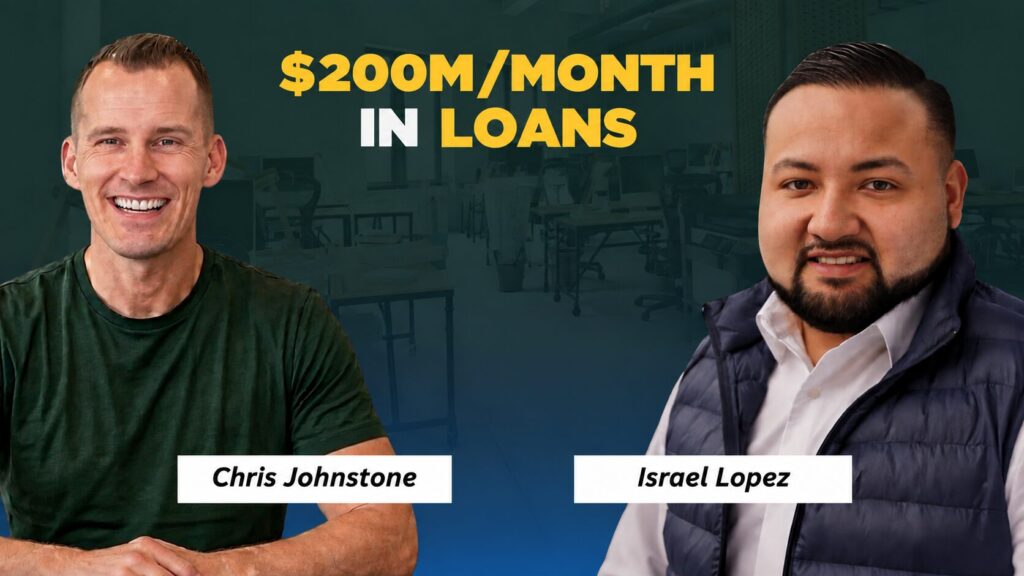
That is exactly what Israel Lopez describes in his LoanOfficerPodcast.com conversation with host Chris Johnstone.
Israel Lopez is a Sales Director at Certain Lending, where the company focuses primarily on the non-QM lending space. The company’s product focus includes fixed and flip financing, ground-up construction, DSCR loans and bank statement loans.
Israel explains that the company has built a highly specialized business rather than attempting to serve every type of mortgage borrower.
The results discussed in the episode are significant.
The company grew from approximately $3 million in monthly production to more than $200 million per month, while Israel personally describes production ranging from approximately $10 million in a slower month to $30 million in a strong month.
The business also has a team of approximately 25 loan officers receiving leads generated through the company’s marketing system.
This guide breaks down the strategies discussed in the podcast, including non-QM specialization, mortgage lead generation, social media content, paid advertising, referral marketing, speed-to-lead and the emerging role of AI in mortgage advertising.
Who Is Israel Lopez?
Israel Lopez is a mortgage professional and Sales Director at Certain Lending.
His focus is primarily on non-QM financing.
The company works with products including:
- DSCR loans
- Bank statement loans
- Fix and flip financing
- Ground-up construction loans
- Hard money financing
- Investor-focused lending
Israel explains that the company operates nationally, with clients across the United States.
Rather than trying to compete across every mortgage category, the company selected a specific niche and built its business around it.
That specialization is one of the central themes of the conversation.
What Is Non-QM Lending?
Non-QM, or non-qualified mortgage lending, refers to mortgage products designed for borrowers who may not fit traditional qualified mortgage underwriting criteria.
In Israel Lopez’s business, the focus is heavily oriented toward real estate investors and borrowers who require alternative documentation or financing structures.
The podcast specifically discusses several non-QM products.
DSCR Loans
Debt Service Coverage Ratio, or DSCR, loans are commonly used by real estate investors.
Rather than focusing entirely on the borrower’s personal income, DSCR financing evaluates the property’s ability to support its debt obligations.
This makes DSCR loans particularly relevant to investment properties.
Bank Statement Loans
Bank statement loans can provide an alternative documentation method for borrowers whose income may not be straightforward to document through traditional W-2 income.
This can be particularly relevant for self-employed borrowers and business owners.
Fix and Flip Financing
Fix and flip financing is designed around real estate investors purchasing properties, renovating them and selling them.
Israel’s company focuses on this type of investor financing as part of its non-QM lending niche.
Ground-Up Construction Loans
Ground-up construction financing supports investors and developers building properties from the ground up.
These transactions require specialized knowledge, making specialization particularly valuable.
The Power of Choosing a Mortgage Niche
One of the most important lessons from Israel Lopez’s business is the value of specialization.
Instead of trying to become everything to everyone, Certain Lending focuses heavily on non-QM lending.
That allows the company to build expertise around a specific customer base and a specific group of mortgage products.
For loan officers, specialization can also make marketing easier.
Instead of creating generic messaging such as:
“We offer mortgage loans.”
a lender can create messaging around a specific problem.
For example:
- DSCR loans for real estate investors
- Bank statement loans for self-employed borrowers
- Fix and flip loans for investors
- Construction financing for real estate developers
- Non-QM loans for borrowers who do not fit traditional financing
The more specific the message, the easier it becomes to build content and advertising around the audience.
From $3M to More Than $200M in Monthly Loan Volume
One of the biggest measurable results discussed in the podcast is the growth of the company.
Israel explains that the company went from approximately $3 million in production to more than $200 million per month.
He describes the company as having grown into an organization of approximately 120 people.
This growth is important because Israel did not simply join an established organization with a large book of business.
He explains that he did not have a book of business when he started.
Instead, he grew with the company and took on different responsibilities as the company evolved.
His experience included working with construction draws and later taking over the appraisal department.
That operational background gave him exposure to different parts of the lending process.
Israel Lopez’s Personal Loan Production
Israel also discusses his own production.
He describes closing approximately:
- $10 million in a slower month
- $30 million in a strong month
He notes that production fluctuates.
The numbers demonstrate the scale of the business he personally handles while also participating in a larger sales and marketing organization.
For mortgage professionals, the important lesson is not simply the production number.
It is how the production is supported by specialization, marketing, content, paid advertising and a broader sales team.
Building a Team of 25 Loan Officers
A major component of Israel’s current model is the team.
He explains that his marketing system generates leads that are distributed to a team of approximately 25 loan officers.
Interestingly, Israel says that he does not necessarily receive those cold leads himself.
The marketing content may feature his face, but the leads are distributed to the sales team.
This creates a distinction between personal branding and lead ownership.
Israel’s personal brand helps attract attention, while the organization provides the sales capacity to handle the resulting opportunities.
How Personal Branding Can Feed a Mortgage Sales Team
Israel explains that he creates content consistently.
The process includes filming content on Sundays.
He describes producing approximately 40 videos per month.
Some of those videos are posted organically.
Other videos are given to the marketing team for use in paid campaigns and advertising.
This creates a content engine.
The basic process is:
Create content → Publish content → Turn content into ads → Generate leads → Qualify leads → Distribute leads to loan officers
That system allows one person’s content to support an entire sales organization.
The 40-Video Monthly Content Strategy
Israel explains that his team creates approximately 40 videos each month.
The videos are then used across different parts of the marketing strategy.
Some are published on social media.
Others are used by the marketing team for advertising campaigns.
This is an important distinction for loan officers.
Content does not have to serve only one purpose.
A single video can potentially become:
- An Instagram Reel
- A Facebook video
- A YouTube Short
- A TikTok
- A paid advertisement
- A retargeting asset
- Website content
- Email content
The goal is to create a repeatable content production system rather than constantly trying to invent new marketing ideas.
Why Consistency Matters in Mortgage Marketing
Israel’s approach demonstrates a strong emphasis on consistency.
His team films on Sundays and distributes content throughout the week.
He describes posting from Monday through Sunday.
That means the marketing operation is not dependent on creating something new every day.
Instead, content is produced in batches.
Batch production can help loan officers maintain consistency without having to interrupt their sales activities every day to create content.
Turning Organic Content Into Paid Ads
One of the more interesting parts of Israel’s marketing system is the relationship between organic content and paid advertising.
Some of the videos are not published organically.
Instead, they go directly to the marketing team.
The marketing team then uses those assets in campaigns and advertisements.
This creates a feedback loop:
Content → Advertising → Leads → Sales Conversations → Closed Loans
For mortgage businesses, this approach can create a scalable marketing system when the creative, targeting, lead qualification and sales process work together.
Spending $100,000 Per Month on Mortgage Advertising
Israel says his organization spends approximately $100,000 per month on paid advertising.
He also says the campaigns generate approximately 4–5X return on ad spend (ROAS).
These are the figures discussed by Israel in the podcast and should be viewed as his reported results, not as a guaranteed outcome for other mortgage businesses.
The key takeaway is that paid advertising is not treated as a small experimental channel.
It is a major component of the company’s lead generation system.
Understanding ROAS in Mortgage Marketing
ROAS stands for Return on Ad Spend.
For example, a 4X ROAS means that for every $1 spent on advertising, the campaign generates $4 in attributed revenue.
Israel reports approximately 4–5X ROAS from the advertising system discussed in the episode.
For loan officers considering paid ads, this highlights the importance of tracking more than clicks.
Mortgage advertising should ultimately be connected to business outcomes such as:
- Qualified leads
- Applications
- Funded loans
- Loan volume
- Revenue
- Cost per acquisition
- Return on advertising spend
The Importance of Lead Qualification
Generating leads is only one part of Israel’s system.
He explains that the company also has an inside sales team that qualifies and disqualifies leads.
This is important because not every person who submits a form is ready to speak with a loan officer.
A qualification process can help determine:
- Whether the borrower fits the product
- Whether the borrower has a viable transaction
- Whether the borrower is ready to move forward
- Which loan officer should receive the lead
This allows the sales team to spend more time on qualified opportunities.
Speed-to-Lead and Mortgage Conversion
In a digital mortgage marketing system, timing matters.
When a potential borrower submits a form, the business needs a process for responding quickly.
The faster a lead is contacted, the less opportunity there is for the borrower to move to another lender.
Israel’s marketing model combines advertising with an inside sales qualification team and a larger loan officer team.
That creates a structured path from advertisement to sales conversation.
Building a Non-QM Lead Generation Funnel
A non-QM lead generation funnel can be structured around a specific borrower problem.
For example:
Step 1: Identify the Audience
Choose a specific audience such as real estate investors.
Step 2: Identify the Financing Problem
The investor may need DSCR financing, bank statement financing, fix and flip financing or construction financing.
Step 3: Create Educational Content
Produce short videos explaining the financing option.
Step 4: Promote the Content
Use paid advertising to reach the appropriate audience.
Step 5: Capture the Lead
Send interested prospects to a landing page or lead form.
Step 6: Qualify the Lead
Use an inside sales team or automated process.
Step 7: Assign the Opportunity
Send the qualified lead to an appropriate loan officer.
Step 8: Follow Up
Use phone, email, text and other appropriate communication channels.
Step 9: Close the Loan
Move qualified borrowers through the mortgage process.
This is the type of system that can turn content marketing into a repeatable acquisition channel.
Social Media Marketing for Non-QM Loans
Social media is particularly important to Israel’s strategy.
His content focuses on his expertise in non-QM lending.
Instead of creating generic mortgage content, the messaging can be tailored toward investors and alternative financing.
Examples of content topics could include:
- How DSCR loans work
- Bank statement mortgage requirements
- Fix and flip financing
- Ground-up construction financing
- Investment property financing
- Non-QM mortgage options
- Real estate investor financing
- Common investor financing mistakes
Educational content can help position a loan officer as a specialist.
Why Investor-Focused Mortgage Content Works Differently
Real estate investors often have different questions from traditional homebuyers.
An investor may be thinking about:
- Cash flow
- Rental income
- Property value
- Leverage
- Renovation costs
- Construction budgets
- Exit strategies
- Debt service coverage
- Investment returns
That gives specialized lenders many opportunities to create educational content.
Instead of simply advertising a loan product, the lender can answer the questions investors are already asking.
Referral Marketing Still Matters
Although Israel’s organization invests heavily in paid advertising, referrals remain an important part of mortgage lending.
Mortgage businesses can combine digital marketing with relationships involving:
- Realtors
- Real estate investors
- Builders
- Contractors
- CPAs
- Attorneys
- Financial professionals
- Previous clients
A strong digital marketing system does not eliminate relationships.
It can complement them.
The Role of AI in Mortgage Marketing
AI is another major theme in the conversation.
Chris Johnstone discusses the emerging opportunity to advertise through AI-powered search platforms.
The discussion specifically references ChatGPT and the potential for AI platforms to become another advertising and discovery channel.
The broader idea is that consumer search behavior is changing.
Instead of only typing queries into traditional search engines, consumers are increasingly asking AI tools questions directly.
That creates a new opportunity for mortgage professionals to think about AI search visibility.
What AI Search Could Mean for Non-QM Lenders
Consider an investor asking an AI assistant:
“What type of loan can I use to purchase an investment property if I don’t want to use traditional income documentation?”
A lender that has built strong digital content around bank statement loans, DSCR loans and non-QM financing may have an opportunity to become visible in that conversation.
This is why creating useful, authoritative mortgage content is increasingly important.
Loan officers should think beyond traditional SEO.
They should also consider how their content can be understood and surfaced by AI-powered search systems.
Creating Mortgage Content for Google and AI Search
For mortgage professionals, strong content should answer specific questions.
Examples include:
- What is a DSCR loan?
- How does a DSCR mortgage work?
- What are bank statement loans?
- How do fix and flip loans work?
- What is non-QM financing?
- Who qualifies for a non-QM mortgage?
- What is a bank statement mortgage?
- How much down payment is required for an investment property?
- Can real estate investors qualify for DSCR financing?
- What is a ground-up construction loan?
This type of content can help establish topical relevance around non-QM lending.
How Loan Officers Can Build a Mortgage Content Engine
Israel’s content strategy provides a useful framework.
A loan officer could create content around one specialized topic every week.
For example:
Monday: DSCR loan education
Tuesday: Investor financing tip
Wednesday: Bank statement loan FAQ
Thursday: Fix and flip financing
Friday: Real estate investor case study
Saturday: Common mortgage mistake
Sunday: Market or financing update
The important part is consistency.
From One Video to Multiple Marketing Assets
A single educational video can be repurposed into multiple formats.
For example, a video titled:
“3 Things Real Estate Investors Should Know About DSCR Loans”
could become:
- YouTube video
- YouTube Short
- Instagram Reel
- Facebook Reel
- LinkedIn post
- Blog post
- Email newsletter
- Website FAQ
- Paid advertisement
This creates more marketing output without requiring completely different ideas for every platform.
What Mortgage Professionals Can Learn From Israel Lopez
There are several practical lessons from Israel’s business model.
Specialize
Israel’s company focuses heavily on non-QM lending rather than attempting to serve every borrower type.
Build a Content System
Approximately 40 videos per month create a large library of marketing assets.
Use Content for Paid Advertising
Some content is specifically handed to the marketing team for campaigns.
Build a Sales Team Around Marketing
The advertising system feeds leads to an inside sales team and approximately 25 loan officers.
Track Advertising Performance
Israel reports approximately 4–5X ROAS on approximately $100,000 per month in advertising spend.
Use Personal Branding
Israel’s face and expertise are used to attract attention, even when the resulting leads are distributed to other loan officers.
Embrace Technology
AI and other technologies are becoming increasingly important to mortgage marketing and operations.
A Practical Non-QM Marketing Strategy for Loan Officers
If you’re a loan officer looking to build a non-QM business, the strategy discussed in this episode can be translated into a practical framework.
Start by selecting one audience.
For example:
Real estate investors.
Then select the products that solve their problems:
- DSCR loans
- Bank statement loans
- Fix and flip loans
- Construction loans
Next, create educational content around those products.
Publish consistently.
Track which content generates engagement.
Turn the strongest content into advertising.
Capture leads.
Qualify them.
Follow up quickly.
Then measure the results.
The objective is to create a system rather than rely entirely on referrals or random inbound leads.
Frequently Asked Questions About Israel Lopez and Non-QM Lending
What does Israel Lopez specialize in?
Israel Lopez specializes in non-QM lending, including DSCR loans, bank statement loans, fix and flip financing and ground-up construction financing.
How much does Israel Lopez produce in loan volume?
Israel says he closes approximately $10 million in a slower month and up to $30 million in a strong month.
How much does the company produce?
Israel explains that the company grew from approximately $3 million to more than $200 million in monthly production.
How many loan officers are on Israel’s team?
Israel describes a team of approximately 25 loan officers receiving leads generated through the marketing system.
How much does the company spend on advertising?
Israel says the company spends approximately $100,000 per month on paid advertising.
What ROAS does Israel report?
Israel reports approximately 4–5X return on ad spend.
How many videos does Israel’s team create?
Israel says they create approximately 40 videos per month, with some used for organic content and others supplied to the marketing team for paid campaigns.
What types of non-QM loans does Certain Lending focus on?
The podcast specifically discusses DSCR loans, bank statement loans, fix and flip financing and ground-up construction financing.
Final Takeaways
Israel Lopez’s mortgage business provides a case study in how specialization, content, paid advertising and sales infrastructure can work together.
The company focused on a specific niche: non-QM lending.
From there, it built a marketing engine around educational video content, paid advertising and lead qualification.
The podcast describes a business that grew from approximately $3 million to more than $200 million in monthly production, while Israel personally reports production ranging from approximately $10 million to $30 million per month.
The organization also uses approximately 40 videos per month, a team of approximately 25 loan officers, and approximately $100,000 per month in paid advertising, with Israel reporting 4–5X ROAS.
For mortgage professionals, the broader lesson is about building systems.
A loan officer does not necessarily need to post random content every day, chase every possible borrower or advertise every mortgage product.
A more focused approach can be built around:
A specific niche + valuable content + paid distribution + lead qualification + sales follow-up + measurable results.
For Israel Lopez, that niche is non-QM lending.
For other mortgage professionals, the opportunity is to determine which audience they can serve best, create useful content for that audience and build a repeatable system for turning attention into qualified mortgage opportunities.
📣 Share This With Another Loan Officer!
