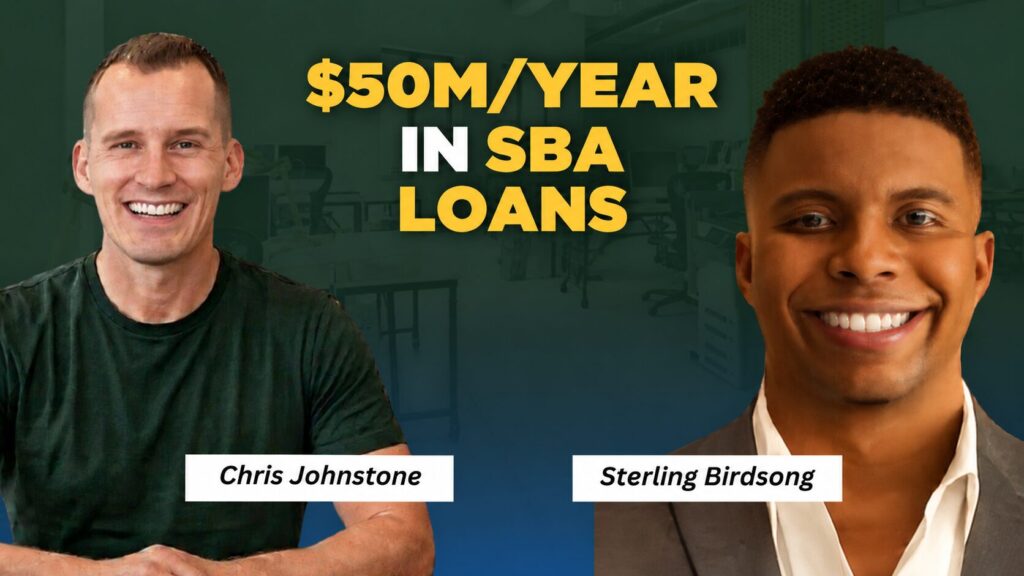
How Sterling Birdsong Built $50M/Year in SBA Loan Production
Introduction
Mortgage lenders who primarily work in residential lending occasionally encounter opportunities that do not fit neatly into a traditional residential mortgage.
A client may want to purchase a commercial property. A business owner may want to acquire a company. A Realtor may have a client looking to purchase an owner-occupied business property. A residential borrower may also own a business and need financing for commercial real estate.
According to Sterling Birdsong, these situations can create significant opportunities for mortgage professionals who understand when to recognize an SBA financing opportunity and where to send the deal.
Sterling Birdsong began his banking career in 2012 as an underwriter. After three years, he moved into the sales side of banking and became an SBA loan officer in 2016.
He spent approximately 10 years as an SBA loan officer and said he averaged approximately $50 million per year in loan production, particularly during his time at BayFirst.
He later left banking and founded Lenstra, a nationwide SBA loan brokerage.
His experience provides a useful framework for mortgage lenders who want to understand SBA financing, identify commercial opportunities, develop referral relationships, and use modern marketing and AI technology to generate business.
Who Is Sterling Birdsong?
Sterling Birdsong started in banking in 2012.
His first role was as an underwriter, which he held for approximately three years.
He eventually moved into sales in 2016 and became an SBA loan officer.
Sterling remained in SBA lending for approximately 10 years and changed banks during that period, joining BayFirst in 2021.
During his time at BayFirst, he said he averaged approximately $50 million per year in loan production.
He eventually left banking in December and founded Lenstra, a nationwide SBA loan brokerage.
Rather than working directly for a bank, Sterling now works directly with customers and accesses a network of banks.
Lenstra internally underwrites the opportunities, takes them to its lending market, attempts to obtain multiple term sheets and works with the customer through the closing process.
What Is an SBA Loan?
An SBA loan is financing supported through programs administered by the U.S. Small Business Administration.
In Sterling Birdsong’s business, SBA financing is particularly relevant for commercial opportunities involving operating businesses.
The important distinction is that SBA financing is not simply a replacement for a conventional residential mortgage.
The borrower and business purpose matter.
One of the most important concepts Sterling discusses is owner occupancy.
What Types of SBA Loans Does Sterling Birdsong Work With?
Sterling says Lenstra primarily works with opportunities between approximately $500,000 and $5 million.
The company can go beyond $5 million, particularly for certain real estate transactions.
The primary focus is on owner-occupied transactions.
Sterling explains that the business generally needs to occupy at least 51% of the square footage of the property being acquired.
Examples discussed in the podcast include:
- Plumbing companies purchasing buildings
- HVAC companies purchasing buildings
- Assisted living facilities
- Car washes
- Hotels
- Marinas
- Gas stations
- Self-storage facilities
- Business acquisitions
- Commercial real estate purchases
- Working capital for existing businesses
This makes SBA financing particularly relevant to mortgage lenders who occasionally encounter business owners or commercial real estate opportunities.
The 51% Owner-Occupancy Concept
One of the most important concepts for mortgage lenders to recognize is whether the operating business will occupy the property.
Sterling specifically describes owner-occupied transactions where the business occupies at least 51% of the building’s square footage.
For example, consider a plumbing company that wants to purchase its own building.
Or an HVAC company looking to acquire a facility where it will operate.
These situations can potentially create SBA financing opportunities.
By contrast, a pure landlord transaction does not fit the same framework.
Sterling also specifically notes that multifamily properties are not SBA eligible under the situation being discussed.
SBA Commercial Real Estate Financing
Commercial real estate is one of the major SBA opportunities Sterling discusses.
Mortgage professionals may encounter commercial real estate opportunities when working with business owners, Realtors or existing clients.
Examples include businesses purchasing their own operating property.
Special-use properties can also be relevant.
Sterling specifically mentions:
- Hotels
- Car washes
- Gas stations
- Marinas
- Assisted living facilities
- Self-storage facilities
These types of properties can involve specialized financing considerations.
For a residential mortgage lender, recognizing that the opportunity exists can be more important than knowing every SBA guideline.
SBA Business Acquisition Loans
Business acquisitions are another major use of SBA financing.
Sterling describes business acquisition financing as one of the most popular uses of the SBA program.
A borrower may want to purchase an existing business rather than start one from scratch.
SBA financing can become relevant to these transactions.
Sterling refers to business acquisition as “BizAC” and describes it as an important part of the SBA ecosystem.
For mortgage professionals, the lesson is simple:
If an existing client tells you they are buying a business, do not automatically assume you need to turn the opportunity away.
Instead, recognize it as a potential SBA financing conversation.
SBA Working Capital Loans
Sterling also discusses working capital.
He explains that an existing business that has been operating for approximately two years, has good credit and demonstrates good cash flow may have access to working capital financing.
He mentions approximately $350,000 or less, depending on the borrower’s circumstances, as an example of this type of financing.
This gives mortgage lenders another potential signal to watch for.
A client does not necessarily need to be purchasing real estate for an SBA opportunity to exist.
How Mortgage Lenders Can Identify SBA Opportunities
Sterling’s message to residential mortgage lenders is straightforward.
You do not need 10 years of SBA expertise to recognize that a potential SBA opportunity exists.
You also do not need to read a 400-page SBA SOP before starting the conversation.
Instead, recognize the signals.
Look for:
- Business owners
- Commercial property purchases
- Owner-occupied real estate
- Business acquisitions
- Special-use properties
- Existing businesses seeking working capital
- Clients purchasing buildings for their operating businesses
- Realtors bringing commercial opportunities
- Clients looking to acquire businesses
Once you identify the opportunity, partner with an SBA specialist.
Why Mortgage Lenders Should Not Say “I Don’t Do SBA”
One of the strongest lessons from Sterling’s approach is that mortgage lenders do not necessarily have to reject opportunities simply because they do not personally specialize in SBA lending.
Sterling describes the alternative.
A mortgage lender can tell the customer:
“We partner with Lenstra, and that’s who handles our SBA opportunities.”
The mortgage lender can introduce the customer to the SBA specialist.
Lenstra then takes responsibility for the transaction.
According to Sterling, Lenstra also pays a 20% referral fee of its gross commission for qualifying introductions.
This creates a potential way for mortgage professionals to monetize opportunities outside their normal residential mortgage specialty.
How SBA Referral Partnerships Work
The referral model described by Sterling is relatively simple.
Step 1: Identify the Opportunity
The mortgage lender encounters a potential commercial or business financing opportunity.
Step 2: Recognize the SBA Signal
The borrower may be purchasing an owner-occupied commercial property, acquiring a business or seeking another form of SBA financing.
Step 3: Introduce the SBA Specialist
The lender connects the borrower with Lenstra.
Step 4: Let the Specialist Handle the SBA Process
Lenstra underwrites the opportunity internally, shops the market for term sheets and helps move the transaction toward closing.
Step 5: Receive the Referral Fee
Sterling says Lenstra pays 20% of its gross commission as a referral fee for the introduction.
This approach allows the residential lender to retain the relationship without needing to become an SBA underwriting expert.
How Mortgage Lenders Can Generate SBA Leads
Sterling describes SBA lead generation as an area that has historically relied heavily on traditional relationship marketing.
He says the SBA space has traditionally been driven by:
- CPAs
- Brokers
- Networking
- Professional relationships
- Referrals
He notes that many people in the SBA lending space do not traditionally run advertisements.
That creates an opportunity for lenders willing to approach SBA marketing differently.
SBA Lead Generation Through Paid Advertising
Sterling says his company has started experimenting with paid advertising.
His view is that targeted advertising could create a new inbound flow of SBA opportunities.
Instead of running generic advertising, he suggests targeting specific industries.
Potential industry-specific campaigns could focus on businesses such as:
- Restaurants
- Law firms
- Medical practices
- Other specific business categories
The goal is to create funnels designed around a specific type of customer.
Why Industry-Specific SBA Marketing Matters
A restaurant owner may have very different financing needs from a doctor.
A lawyer may have different concerns from a hotel operator.
A business acquisition buyer may require different messaging from an owner looking to purchase commercial real estate.
Sterling’s approach is to create industry-specific funnels and advertising creatives.
This allows the marketing message to be much more relevant to the target borrower.
Sterling Birdsong’s Meta Advertising Strategy
In the post-recording conversation, Sterling explains that his team is building different Meta funnels based on industry type.
He discusses potentially creating approximately 20 different pixels, with separate funnels and creative assets for specific customer types.
Examples include:
- Restaurant funnel
- Lawyer funnel
- Doctor funnel
His theory is that Meta’s advertising system can become more accurate when the advertiser gives the platform a very specific customer type.
This was presented as Sterling’s current strategy and research-based approach, rather than a guaranteed advertising result.
AI and the Future of SBA Lending
Artificial intelligence was another major theme of the conversation.
Sterling says he is seeing AI across multiple parts of the lending business.
According to him, AI is appearing at the:
- Front end
- Middle of the process
- Back end of the process
This includes the way borrowers search for information and the way lenders process and underwrite loans.
How AI Is Changing Mortgage and SBA Lead Generation
Sterling agrees that people are increasingly using AI tools as search engines.
Borrowers can use tools such as:
- ChatGPT
- Claude
- Grok
to research financing options.
That means lenders need to consider not only traditional search engines but also how their businesses appear within AI-powered search and recommendation systems.
For SBA lenders and mortgage professionals, this creates a new marketing opportunity.
A borrower may use AI to research SBA financing, identify the type of financing they need and eventually ask:
“Who should I talk to?”
The companies and professionals that become visible during that process can potentially enter the borrower’s consideration set.
AI for SBA Lending Operations
Sterling also discusses using AI internally.
He describes Lenstra as a technology-forward business and says AI has helped him scale faster without making as many hires.
For an entrepreneur, that can potentially improve the economics of the business.
Sterling’s broader philosophy is that AI should be incorporated into the lending process wherever it can improve efficiency.
AI at the Front End, Middle and Back End
Sterling describes AI as being useful throughout the lending process.
At the front end, AI can influence:
- Search
- Lead generation
- Customer education
- Marketing
In the middle of the process, technology can assist with:
- Underwriting
- Processing
- Customer communication
- Workflow
At the back end, AI and technology can help make the process more seamless for:
- Customers
- Banks
- Lending teams
The goal is not simply to add AI because it is popular.
The goal is to make the process more efficient.
Why AI Can Help SBA Lenders Scale
Sterling specifically says AI has helped him scale faster without having to make as many hires.
This is an important lesson for mortgage lenders and SBA brokers.
Growth normally creates additional operational demands.
More leads can mean:
- More calls
- More applications
- More underwriting
- More follow-up
- More documentation
- More customer communication
If technology can automate or streamline appropriate parts of that process, a business may be able to handle additional volume more efficiently.
SBA Rule Changes and Business Acquisitions
Another major topic in Sterling’s interview was a new SBA rulebook affecting acquisitions.
Sterling explained that a new SOP had been released and that October 1 would bring a new set of rules, particularly affecting business acquisitions.
He said existing business owners purchasing real estate would not be impacted as significantly as certain business acquisition transactions.
Changes to SBA Acquisition Underwriting
Sterling discussed a significant change involving projections.
Previously, certain transactions could be supported by projections showing that a property or business would improve its cash flow after acquisition.
Sterling explained that under the new rules discussed in the podcast, borrowers would need to demonstrate a 1.25 debt service coverage ratio based on historical performance, using either the last fiscal year or an average of the two most recent fiscal years.
This means projected future improvements could no longer be relied upon in the same way for the affected transactions.
What the SBA Rule Changes Could Mean for Commercial Real Estate
Sterling believes the new requirements could significantly affect certain SBA commercial real estate transactions.
One potential result he anticipates is increased use of seller notes.
If the transaction does not meet the required historical debt service coverage ratio, Sterling expects sellers may need to reduce the price or hold more paper to make the transaction work.
This creates another important consideration for Realtors, business brokers, borrowers and mortgage professionals involved in SBA transactions.
SBA Eligibility and Legal Permanent Residents
Sterling also discusses another SBA eligibility change.
According to his comments in the podcast, legal permanent residents, or green card holders, were no longer eligible for SBA financing under the rule he was describing.
He stated that if a business had an owner with even 1% ownership who was an LPR, the business would no longer be eligible for SBA financing under that rule.
Because SBA rules can change, lenders should verify current eligibility requirements before advising borrowers on a transaction.
Why SBA Rule Changes Create Marketing Opportunities
Rule changes do not only create challenges.
They can also create reasons for mortgage lenders and Realtors to contact their databases.
Sterling and Chris discuss the idea of using changing SBA guidelines as educational content.
For example, a lender could create:
- SBA guideline updates
- Realtor newsletters
- Client emails
- Educational social media posts
- Database campaigns
- Commercial financing alerts
The purpose is to educate referral partners and borrowers about changes that could affect their financing plans.
How to Use SBA Education to Generate Referrals
Mortgage professionals can use education as a reason to contact their database without directly asking for business.
Instead of sending:
“Do you have anyone who needs a loan?”
a lender can provide useful information about:
- SBA rule changes
- Business acquisition financing
- Commercial real estate financing
- Owner-occupied property
- Working capital
- SBA eligibility
- Debt service coverage requirements
This positions the lender as a resource.
A Practical SBA Lead Generation Strategy for Mortgage Lenders
Based on Sterling’s discussion, mortgage lenders can build an SBA opportunity strategy around five areas.
1. Mine Your Existing Database
Look for clients who own businesses.
2. Educate Your Referral Partners
Teach Realtors, CPAs and other professionals about SBA opportunities.
3. Identify Commercial Opportunities
Watch for owner-occupied commercial real estate and business acquisition opportunities.
4. Build Industry-Specific Marketing
Create targeted campaigns for specific industries.
5. Develop an SBA Referral Partnership
Have a specialist available so you can confidently refer opportunities instead of rejecting them.
SBA Opportunities Mortgage Lenders Should Watch For
Here are the major signals Sterling discusses.
Owner-Occupied Commercial Real Estate
The business will occupy at least 51% of the property.
Business Acquisitions
A borrower wants to purchase an existing business.
Special-Use Properties
Examples include hotels, car washes, gas stations, marinas and assisted living facilities.
Existing Businesses Seeking Working Capital
Businesses with operating history, credit and cash flow may have working capital needs.
Residential Clients Who Own Businesses
A person looking for a residential mortgage may also own a business that needs commercial financing.
This is one of the easiest opportunities for residential lenders to overlook.
How to Build an SBA Referral Network
A mortgage lender does not have to become an SBA expert to create an SBA referral network.
Start by identifying experienced SBA professionals.
Potential referral relationships can include:
- SBA loan brokers
- SBA lenders
- Commercial real estate professionals
- Business brokers
- CPAs
- Attorneys
- Financial advisors
- Realtors
The objective is to know exactly who to contact when an SBA opportunity appears.
Why Mortgage Lenders Should Learn the SBA Basics
Sterling does not suggest that residential mortgage lenders need to become SBA underwriting experts.
Instead, they should understand the basic signals.
Knowing that SBA financing can potentially apply to a $500,000 to $5 million owner-occupied commercial opportunity may be enough to recognize when to make a referral.
The specialist can then handle the detailed underwriting.
The $50 Million Loan Production Lesson
Sterling’s approximately $50 million average annual loan production provides context for the depth of experience he brings to SBA lending.
He describes a typical strong business development officer as producing approximately $15 million to $20 million.
Against that benchmark, his reported production demonstrates the scale of SBA lending experience he developed before founding Lenstra.
His lesson for mortgage professionals is not simply to chase volume.
It is to recognize opportunities, specialize, build relationships and develop systems that allow you to serve customers efficiently.
A Step-by-Step SBA Strategy for Loan Officers
Mortgage lenders can use the following framework based on Sterling’s discussion.
Step 1: Review Your Database
Identify clients who own businesses.
Step 2: Ask Better Questions
During conversations, ask whether clients are purchasing, expanding or acquiring commercial property or businesses.
Step 3: Learn the SBA Signals
Understand owner occupancy, business acquisitions, commercial real estate and working capital.
Step 4: Find an SBA Partner
Build a relationship with an experienced SBA lender or broker.
Step 5: Educate Realtors
Teach your Realtor partners how to identify SBA opportunities.
Step 6: Create Content
Publish useful information about SBA financing and changing guidelines.
Step 7: Experiment With Paid Advertising
Consider industry-specific advertising funnels.
Step 8: Use AI
Explore AI for marketing, search visibility, underwriting support and operational efficiency.
Step 9: Follow Up
Stay connected with borrowers and referral partners.
Step 10: Track Results
Measure which referral sources, industries and marketing channels produce qualified SBA opportunities.
Frequently Asked Questions About Sterling Birdsong and SBA Lending
Who is Sterling Birdsong?
Sterling Birdsong is an SBA lending professional who began his banking career in 2012, became an SBA loan officer in 2016 and later founded Lenstra, a nationwide SBA loan brokerage.
How much SBA loan production did Sterling Birdsong report?
Sterling said he averaged approximately $50 million per year in loan production, particularly during his time at BayFirst.
What size SBA loans does Lenstra primarily work with?
Sterling said Lenstra primarily works with approximately $500,000 to $5 million transactions, with the ability to go beyond $5 million primarily for real estate deals.
What type of SBA real estate deals does Lenstra work with?
Sterling primarily described owner-occupied transactions where the operating business occupies at least 51% of the building.
Can SBA loans be used for business acquisitions?
Yes. Sterling described business acquisitions as one of the most popular uses of SBA financing.
What businesses can potentially use SBA financing?
Sterling discussed businesses and properties including plumbing companies, HVAC companies, assisted living facilities, car washes, hotels, marinas, gas stations and self-storage facilities.
How can a residential mortgage lender find SBA opportunities?
Sterling recommends watching for commercial real estate, business acquisitions, special-use properties and business owners who may need financing beyond their residential mortgage.
Does Sterling’s company pay mortgage lenders for referrals?
Sterling said Lenstra pays a 20% referral fee of its gross commission for qualifying introductions.
How is AI being used in SBA lending?
Sterling discussed AI across the front end, middle and back end of the lending process, including search, underwriting and operational processes.
Can mortgage lenders use AI for SBA lead generation?
Sterling believes AI and digital advertising can create additional inbound opportunities. He also discussed industry-specific Meta funnels and the growing role of AI-powered search.
Final Takeaways
Sterling Birdsong’s career provides a useful case study in specialized lending.
He began in banking in 2012, moved into SBA lending in 2016 and eventually averaged approximately $50 million in annual loan production.
Today, through Lenstra, he works with SBA borrowers across the country and focuses primarily on transactions between $500,000 and $5 million.
For residential mortgage lenders, the biggest opportunity may not be becoming an SBA expert.
It may simply be learning how to recognize an SBA opportunity.
A residential client could own a business.
A Realtor could have a commercial buyer.
A borrower could want to acquire an existing company.
A business owner could want to purchase an owner-occupied building.
When these situations appear, a mortgage lender can potentially create value by having the right SBA partner available.
Sterling’s approach also highlights the changing role of technology.
Traditional SBA lending has relied heavily on relationships, CPAs, brokers and networking. Sterling is experimenting with paid advertising, industry-specific funnels, AI and technology-driven processes.
His broader message is that SBA lending is changing.
Mortgage lenders who understand the opportunities, build referral relationships and learn how to use technology can create new ways to serve their customers.
Most importantly, the next time a residential mortgage client says they are buying a business or commercial property, the conversation does not necessarily have to end with:
“We don’t do that.”
It can instead become:
“Let’s see whether this could be an SBA opportunity.”
That shift can turn an otherwise lost opportunity into a new referral, a new revenue stream and a stronger relationship with the client.
📣 Share This With Another Loan Officer!
