How Anthony Casa Is Helping Loan Officers Win With AI, Relationships & Specialty Lending
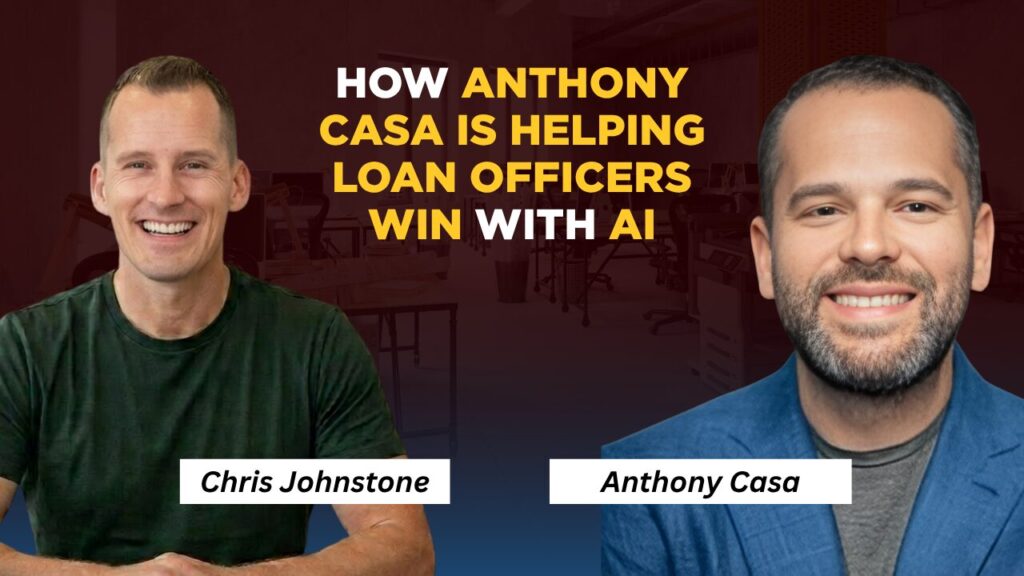
How Loan Officers Can Win With AI, Referral Networks & Specialty Lending: Lessons From Anthony Casa
The mortgage industry is entering a period of significant transformation.
Artificial intelligence is changing how businesses operate. Consumers are beginning to use AI platforms to discover mortgage professionals. Loan fulfillment technology is becoming more efficient. Competition is increasing. And traditional mortgage products alone may no longer be enough to differentiate a loan officer in a crowded market.
But according to Anthony Casa, CEO of UMortgage, one thing is unlikely to disappear anytime soon:
Relationships.
In a conversation with Chris Johnstone on LoanOfficerPodcast.com, Anthony shared his perspective on where mortgage business is coming from today, how loan officers should build referral networks, where artificial intelligence can create real value, why specialty lending is becoming increasingly important, and how authentic social media can build a powerful personal brand.
Anthony’s message is especially relevant for loan officers trying to answer one critical question:
How do you grow a mortgage business in an industry being transformed by AI and technology?
The answer isn’t to abandon traditional relationship-building.
It’s to combine relationships, technology, product knowledge, database management, personal branding, and AI.
This guide breaks down the biggest lessons from the conversation and provides a practical roadmap for loan officers who want to grow their mortgage business over the next several years.
Who Is Anthony Casa?
Anthony Casa is the CEO of UMortgage and has spent his career in the mortgage industry, beginning at just 18 years old in 2003.
Over the years, he has experienced multiple mortgage market cycles and developed a strong perspective on the future of mortgage lending, loan officer technology, broker platforms, and the role of artificial intelligence.
UMortgage operates with a strong focus on helping loan officers build self-generated businesses rather than relying exclusively on centrally generated leads.
That philosophy is central to Anthony’s advice throughout the episode.
Rather than asking loan officers to search for opportunities everywhere, he encourages them to go deeper into the communities they already serve.
That means building relationships with:
- Real estate agents
- Financial advisors
- Attorneys
- Community leaders
- Local professionals
- Past clients
- Other centers of influence
The goal is simple:
Become the loan officer with the strongest network of relationships.
Lesson 1: The Best Mortgage Business Growth Strategy Is Still Relationship Building
Technology is changing the mortgage industry.
But Anthony believes the relationship business remains one of the most powerful advantages a loan officer has.
UMortgage’s model focuses heavily on self-generated business and helping loan officers build relationships within their communities.
Instead of trying to market across all 50 states or constantly chase the latest lead source, the focus is:
How do you go deeper in the community you serve?
That can include:
- Open houses
- Community events
- Networking events
- Realtor relationships
- Financial advisor relationships
- Local outreach
- Database marketing
Anthony makes an important point: many loan officers try to reinvent the wheel when proven strategies still work.
There are loan officers with only one or two years of industry experience who are closing significant numbers of loans simply by consistently executing a relationship-building playbook.
The lesson?
Consistency often beats complexity.
Why Open Houses Still Matter for Loan Officers
Open houses remain a practical opportunity because they bring together two important groups:
- Potential homebuyers
- Real estate agents actively serving homebuyers
For loan officers trying to build a local mortgage business, open houses can create opportunities to meet people face-to-face.
The value isn’t simply collecting leads.
It’s building familiarity.
A consistent presence can help Realtors and buyers begin associating you with the local real estate community.
Instead of asking:
“Where can I find the newest mortgage lead?”
Consider asking:
“Where are my ideal clients and referral partners already gathering?”
Often, the answer is in your local market.
Lesson 2: New Loan Officers Should Start With More Outreach, Then Transition Toward Relationships
One of the most actionable frameworks Anthony shared is how a loan officer’s activity mix should change as their business grows.
For newer loan officers, he recommends something close to a:
70% Outreach / 30% In-Person Strategy
Outreach may include:
- Phone calls
- Emails
- Text messages
- Social media DMs
- Direct outreach to centers of influence
The purpose of outreach is to create opportunities for in-person relationships.
In other words:
The 70% creates the 30%.
But once a loan officer has developed a stronger business foundation—such as consistently closing several loans per month—Anthony recommends flipping the model.
The goal becomes closer to:
30% Outreach / 70% In-Person Relationship Building
That means spending more time:
- Meeting Realtors
- Attending open houses
- Meeting referral partners
- Connecting with clients
- Participating in community activities
This is a valuable way to think about mortgage prospecting.
Your activity should evolve as your business evolves.
The Mortgage Business Growth Framework
Stage 1: Build Your Network
Focus heavily on outreach.
You don’t yet have enough relationships, so you need to create them.
Stage 2: Strengthen Your Network
Turn initial conversations into deeper professional relationships.
Stage 3: Maintain and Expand Relationships
Spend more time with established referral partners while continuing strategic outreach.
Stage 4: Build a Referral Ecosystem
Develop a network where opportunities increasingly come through relationships and referrals.
The mistake many loan officers make is stopping outreach too early.
The opposite mistake is continuing to prospect exactly the same way after building a strong network.
Your strategy should evolve.
Lesson 3: AI Should Help Loan Officers Find More Opportunities, Not Replace Relationships
One of the most important sections of the conversation focused on artificial intelligence.
Anthony described three key areas where AI can add value to loan officers.
The first is scenario-to-structure intelligence.
The mortgage industry has a wide variety of products available, including:
- HELOCs
- Second liens
- Non-QM loans
- Specialty lending
- Construction loans
The challenge is that many loan officers don’t proactively study every product.
Instead, they typically learn about a product when a specific borrower scenario appears.
Anthony sees AI as a potential solution.
Imagine a loan officer entering a borrower scenario into an AI-powered system.
Instead of manually searching through product guidelines, the technology could help surface potential financing options based on the scenario.
This doesn’t eliminate the need for loan officer expertise.
It can make product discovery faster.
How AI Can Help Loan Officers With Mortgage Scenarios
AI-powered mortgage technology may help loan officers:
- Identify possible financing options
- Surface specialty products
- Organize borrower scenarios
- Reduce manual research
- Highlight products they may not have considered
- Improve speed of response
The key is using AI as an intelligence layer.
Technology can help identify possibilities.
The loan officer still provides judgment, advice, communication, and relationship management.
Lesson 4: Specialty Lending Can Help Loan Officers Differentiate Themselves
Anthony believes specialty lending is becoming increasingly important.
Traditional conventional and government lending remains essential.
But those products are widely available.
Almost every mortgage company can offer conventional financing.
That makes product availability alone less of a differentiator.
Anthony specifically highlighted growing opportunities in:
- Non-QM lending
- HELOCs
- Second liens
- Construction lending
- Specialty mortgage products
The opportunity isn’t simply saying:
“Yes, we offer that.”
The opportunity is understanding the products well enough to educate clients and referral partners.
Why Non-QM Lending Can Be a Competitive Advantage
Anthony discussed the expansion of the non-QM mortgage market.
He emphasized that non-QM should not automatically be viewed through the outdated lens that some people associate with higher-risk lending.
According to the discussion, today’s non-QM products can help serve specific borrower segments, including:
- Self-employed borrowers
- Real estate investors
- Borrowers who fall outside traditional agency guidelines
For loan officers, product knowledge can become a relationship-building tool.
Imagine meeting a Realtor who has clients being turned away because they don’t fit into a traditional mortgage box.
If you understand specialty lending, you can provide education and potentially help create more opportunities.
Product Knowledge Is a Door Opener
Anthony describes specialty lending as both a differentiator and a door opener.
Why?
Because knowledge creates conversations.
A loan officer who can educate a Realtor about:
- Non-QM loans
- Bank statement programs
- Investment property financing
- HELOC strategies
- Second lien options
can potentially create value before asking for a referral.
This is a critical concept.
Education can be marketing.
Instead of leading with:
“Send me your next buyer.”
Lead with:
“Here’s something that could help you serve more buyers.”
That approach can create stronger professional relationships.
Lesson 5: AI-Powered Database Management Could Become a Major Competitive Advantage
Anthony’s second major AI focus is autonomous pipeline communication.
Loan officers often have large pipelines containing:
- Pre-approved clients
- Active prospects
- Past clients
- Referral opportunities
- Future borrowers
The challenge isn’t always a lack of contacts.
The challenge is knowing:
Who should I contact today?
This is where AI can become extremely valuable.
Anthony describes a future where AI helps orchestrate loan officer outreach.
For example, instead of manually reviewing the same list repeatedly, technology could help prioritize contacts based on previous communication and potential opportunities.
This could help loan officers avoid redundancy and focus their attention.
AI Can Make Loan Officers More Productive
Chris Johnstone summarized one of AI’s most powerful potential benefits:
AI can help identify the money-making opportunities that deserve human attention.
The goal isn’t necessarily to automate every conversation.
The goal is to remove administrative friction so loan officers can have more meaningful conversations.
Imagine the difference between spending an hour organizing your CRM versus having a system tell you:
“These are the 10 people you should contact today.”
That extra time can be invested in:
- Phone calls
- Client meetings
- Realtor meetings
- Referral relationships
AI can create efficiency.
Humans create relationships.
The combination is powerful.
Lesson 6: Your Database May Become Your Most Important Competitive Asset
Anthony believes the mortgage industry’s servicing landscape is becoming increasingly competitive.
Large companies invest heavily in customer ownership because they understand a fundamental business principle:
The company that stays connected to the customer has a better chance of retaining the customer.
Loan officers face the same challenge.
After a loan closes, other companies may market to that borrower.
If you disappear after closing, you risk becoming irrelevant.
This is why database management matters.
An AI-powered database strategy could help loan officers stay top-of-mind without requiring them to manually remember every follow-up.
How Loan Officers Can Protect Their Database
A strong database strategy should include:
Consistent Communication
Stay in touch beyond the transaction.
Relevant Education
Share information borrowers may find useful.
Personal Outreach
Don’t rely exclusively on automation.
Life Event Awareness
Stay connected as clients experience major changes.
Referral Opportunities
Make it easy for past clients to remember and recommend you.
The future may involve AI helping orchestrate this communication.
But the relationship itself should remain personal.
Lesson 7: AI May Disrupt the Mortgage Industry From the Back End First
One of Anthony’s most interesting predictions concerns where AI disruption will occur.
Many people focus on whether AI will replace the loan officer.
Anthony takes a different view.
He believes the bigger disruption may happen behind the scenes.
Legacy mortgage companies often operate with:
- Older technology
- Legacy processes
- Large operational structures
- Higher fulfillment costs
AI-native companies may be able to build more efficient infrastructure.
Anthony describes the possibility of companies using significantly fewer people while leveraging AI to handle repeatable processes.
The potential result?
Lower costs.
And when costs decrease, consumer pricing may become more competitive.
Why Mortgage Technology Could Increase Competition
Anthony’s argument is straightforward.
If technology makes it:
- Cheaper to process loans
- Easier to fulfill loans
- More efficient to operate
then the economics of mortgage lending could change.
Loan officers may eventually face increased pressure around pricing and margins.
That’s why Anthony emphasizes the importance of sourcing more customers.
The loan officers who can generate consistent business through relationships may be better positioned to compete.
Lesson 8: The Loan Officers With the Largest Referral Networks May Have the Biggest Advantage
Anthony’s strongest advice for loan officers looking ahead is clear:
Build more referral relationships.
He believes technology may disrupt many parts of the mortgage business, but relationship-based business will remain highly valuable.
Potential referral sources include:
- Real estate agents
- Financial advisors
- Attorneys
- Commercial loan officers
- Community leaders
- Past clients
- Other professionals
Anthony’s philosophy is to think bigger about the number of relationships you have.
If you have five referral sources today, how do you build 20?
If you have 20, how do you build 100?
The future advantage may belong to the mortgage professional with the deepest and widest network.
Referral Networks Are an Asset
A strong referral network cannot be built overnight.
It requires:
- Consistency
- Trust
- Follow-up
- Communication
- Value
- Time
That’s exactly what makes it valuable.
Technology can be copied.
Advertising can be copied.
A deep network of trusted relationships is much harder to replicate.
A Simple Referral Network Growth Strategy
Step 1: Identify Potential Centers of Influence
Create a list of:
- Realtors
- Financial advisors
- Attorneys
- Insurance professionals
- Commercial lenders
- Business owners
Step 2: Start Conversations
Use calls, emails, messages, and introductions.
Step 3: Create Value
Don’t immediately ask for business.
Offer education, insights, resources, or useful information.
Step 4: Move Relationships Offline
Meet in person whenever possible.
Step 5: Stay Consistent
Follow up and maintain relationships.
Step 6: Expand the Network
Ask yourself regularly:
Who else should I know?
Lesson 9: AI Search Is Already Becoming a Mortgage Lead Source
One of the most forward-looking parts of the episode focused on AI-powered search.
Anthony said he is increasingly seeing examples of borrowers discovering lenders through AI platforms.
Consumers are beginning to ask conversational questions like:
- Who is the best mortgage lender?
- Who specializes in a particular type of loan?
- Who is a mortgage expert in my area?
AI platforms may then surface names based on information available across the internet.
This changes the future of mortgage marketing.
Traditional SEO is no longer the only consideration.
Loan officers should also think about:
How does AI understand my expertise?
Building AI Search Visibility as a Loan Officer
Anthony gave Chris Johnstone as an example.
When Anthony searched for an AI subject matter expert in the mortgage industry, Chris appeared prominently.
Why?
Anthony’s explanation was based on content.
Chris had built content around AI over time.
The lesson for loan officers is important.
If you want to become known for something, consistently create useful information about it.
For example:
First-Time Homebuyers
Create answers to first-time buyer questions.
VA Loans
Create educational VA loan content.
Jumbo Mortgages
Publish content about high-value financing.
Non-QM Lending
Answer questions for self-employed borrowers.
Local Mortgage Expertise
Create market-specific content.
Over time, your digital footprint can help establish topical relevance.
The Multi-Platform Content Strategy for AI Search
Chris highlighted an important strategy:
Answer questions across multiple formats.
For example:
- Blog posts
- Videos
- Social media posts
The same core topic can be explained in different ways across your content ecosystem.
This creates more opportunities for people—and potentially AI systems—to understand your expertise.
Lesson 10: Build Your Brand in Multiple Places
Anthony also discussed the opportunity to understand where AI systems source information.
He mentioned that loan officers should consider building their brand across multiple relevant platforms rather than relying on a single website or channel.
The broader lesson is:
Don’t build your entire digital identity on rented land.
Your online presence may include:
- Your website
- Google Business Profile
- YouTube
- Podcast appearances
- Industry publications
- Educational resources
The goal isn’t to be everywhere without a strategy.
It’s to create a consistent and credible digital footprint.
Lesson 11: Authentic Social Media Builds Relationships at Scale
Anthony’s approach to social media is particularly valuable for loan officers.
He believes one of the biggest mistakes is creating content that is:
All business, all the time.
Highly transactional content may technically promote your services.
But it doesn’t necessarily help people know you.
Anthony’s social media philosophy is relationship-driven.
People who follow him over time learn about:
- His family
- His habits
- His businesses
- His values
- His wins
- His losses
As a result, some people feel like they already know him before ever speaking to him directly.
That is the power of personal branding.
You Don’t Need to Be Corporate on Social Media
Loan officers often overcomplicate content creation.
They think every post needs:
- Professional lighting
- A studio
- Perfect editing
- A detailed script
Anthony offers a simpler approach.
Document your life consistently.
For example:
- At your child’s game? Share a photo.
- Meeting someone interesting? Share a takeaway.
- Recording a podcast? Share a screenshot.
- Attending an event? Share your experience.
Authenticity can be more sustainable than trying to create polished content every day.
The Social Media Strategy for Loan Officers
Anthony’s advice can be summarized in three principles.
1. Be Authentic
Represent your actual values and personality.
2. Attract the Right People
Don’t try to appeal to everyone.
Attract people you genuinely want to work with.
3. Be Consistent
Consistency matters more than occasional bursts of activity.
A simple daily post can compound over time.
Why Authenticity Is a Mortgage Marketing Advantage
Mortgage lending is a trust-based business.
People want to work with professionals they feel comfortable with.
Social media gives potential clients and referral partners an opportunity to get familiar with you before the first conversation.
Over time:
Content → Familiarity → Trust → Conversation → Opportunity
That is why personal branding can support a relationship-based mortgage business.
Lesson 12: Don’t Wait for Perfect Technology or Perfect Content
A recurring theme throughout the conversation is adaptation.
AI is evolving quickly.
Social media is changing.
Mortgage products are expanding.
The biggest mistake may be waiting until everything is perfectly understood.
Anthony acknowledges that AI will look different six months from now than it does today.
That doesn’t mean you should wait.
It means you should focus on applications that create value now while staying aware of what is changing.
The same applies to content.
Don’t wait for:
- A professional studio
- Perfect editing
- The perfect marketing strategy
- Complete AI expertise
Start building.
Improve over time.
A 12-Month Mortgage Business Growth Plan Inspired by Anthony Casa
Here is a practical framework based on the conversation.
Months 1–3: Expand Your Network
Focus on outreach.
- Contact Realtors
- Meet financial advisors
- Attend networking events
- Visit open houses
- Build a list of centers of influence
Months 4–6: Improve Product Knowledge
Study opportunities beyond traditional lending.
Learn more about:
- HELOCs
- Second liens
- Non-QM
- Construction loans
- Specialty financing
Focus on becoming an educator.
Months 7–9: Improve Your Database Strategy
Audit your CRM.
Identify:
- Past clients
- Pre-approved clients
- Old leads
- Referral sources
- Dormant opportunities
Create a consistent follow-up system.
Use technology to improve prioritization.
Months 10–12: Build Your Personal Brand
Create a sustainable content routine.
You don’t need perfect production.
Start with:
- One useful insight
- One personal moment
- One educational topic
Consistency compounds.
The Modern Mortgage Business Formula
The future mortgage professional may need to combine several capabilities:
Relationships + Product Knowledge + Technology + Database Management + Personal Branding
Let’s break that down.
Relationships
Generate trust and referrals.
Product Knowledge
Help you solve more borrower problems.
Technology
Improves efficiency and opportunity identification.
Database Management
Protects your existing relationships.
Personal Branding
Helps future clients and partners discover and trust you.
No single strategy is enough.
The strongest mortgage businesses may combine all five.
Key Takeaways for Loan Officers
Here are the biggest lessons from Anthony Casa’s conversation.
1. Relationships Remain a Major Competitive Advantage
Technology may disrupt processes, but trusted referral relationships remain valuable.
2. New Loan Officers Should Focus Heavily on Outreach
Use calls, texts, emails, and DMs to create in-person opportunities.
3. Shift Toward In-Person Relationships as You Grow
Once you build a foundation, spend more time deepening relationships.
4. AI Should Help You Find Opportunities
Use technology to reduce administrative work and prioritize conversations.
5. Specialty Lending Creates Differentiation
Learn HELOCs, non-QM, second liens, and other products.
6. Your Database Is a Competitive Asset
Stay connected to prevent clients from forgetting you.
7. AI May Disrupt the Mortgage Industry From the Back End
Operational efficiency may change the economics of lending.
8. Build the Largest Referral Network You Can
The number and quality of your relationships can become a long-term advantage.
9. AI Search Is Becoming Important
Build content and authority around your expertise.
10. Authentic Social Media Builds Trust
Share your values, experiences, wins, losses, and personality.
11. Consistency Beats Perfection
A sustainable daily habit can outperform occasional high-effort campaigns.
Final Thoughts: The Future of Mortgage Business Growth
Anthony Casa’s perspective offers an important balance between traditional mortgage sales and modern technology.
The mortgage industry is changing.
AI will continue to influence:
- Loan fulfillment
- Customer communication
- Database management
- Product discovery
- Consumer search
But that doesn’t mean loan officers should abandon what has always worked.
Relationships remain essential.
The winning strategy may be to use AI to become more efficient while investing the saved time into more human interactions.
Let AI help you:
- Organize your pipeline
- Identify opportunities
- Surface product options
- Manage your database
Then use your time to:
- Call clients
- Meet Realtors
- Build referral relationships
- Attend events
- Serve your community
At the same time, expand your expertise.
Learn specialty products.
Create educational content.
Build your personal brand.
Because as technology makes mortgage lending more competitive, the things that make you memorable become even more important.
Your knowledge.
Your relationships.
Your reputation.
Your network.
Your ability to solve problems.
The future of mortgage lending may be powered by AI.
But according to Anthony Casa’s central message, the loan officers who build the strongest relationships will continue to have a powerful advantage.
Frequently Asked Questions
How can loan officers grow their mortgage business?
Loan officers can grow their business by expanding their referral networks, building stronger relationships within their communities, attending open houses and networking events, improving their product knowledge, managing their database consistently, and using technology to identify opportunities.
How can AI help mortgage loan officers?
AI can potentially help loan officers organize pipelines, prioritize outreach, identify potential product solutions, manage databases, reduce repetitive administrative tasks, and surface opportunities that deserve personal attention.
Why should loan officers learn non-QM and specialty lending?
Specialty lending can help loan officers differentiate themselves and serve borrowers who may not fit traditional conventional or government loan guidelines, including certain self-employed borrowers and investors.
How do loan officers get more referral partners?
Loan officers can build referral networks by consistently meeting Realtors, financial advisors, attorneys, and other centers of influence. The focus should be on providing value and building genuine relationships over time.
Can AI platforms generate mortgage leads?
The conversation indicates that borrowers are increasingly using AI platforms to discover lenders. Building a strong online presence, publishing useful content, earning reviews, and establishing expertise across multiple platforms may improve visibility.
What should loan officers post on social media?
Loan officers can combine educational mortgage content with authentic personal content. Sharing professional insights, personal experiences, family moments, community involvement, and industry perspectives can help people get to know the person behind the business.
📣 Share This With Another Loan Officer!
